game

| title | Strider (US set 1) |
| set name | strider |
| manufacturer | Capcom |
| year | 1989 |
| genre | Platform / Fighter Scrolling (hof) |
| category | Platform / Fighter Scrolling (hof) |
| driver status | good |
| driver source | cps1.c |
| snapshots | PS: in game
| title
| scores
/ MW: in game
/ CT: in game
| title
| wallpaper
/ EJ: in game
/ artwork: cabinet
| marquee
| PCB
zoom 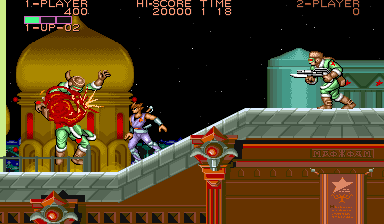
|
| rating |   76.8% after 71 votes |
| clones | Strider (US set 2) Strider Hiryu (Japan Resale Ver.) Strider Hiryu (Japan) |


display
| colour emulation | good |
| palette | 3072 |
| display type | raster |
| orientation | horizontal |
| resolution | 384x224 |
| frequency | 59.610000Hz |
sound
| sound emulation | good |
| channels | mono |
controls
| players | 2 |
| nplayers | 2P alt |
| controls | 8 way joystick |
| buttons | 3 |
| coin slots | 2 |
hardware
data
| version added | .031 | ||||||||||||||||||||||||||||||||||||||||||||||||||||||||||||||||||||||||||||||||||||||||||||||||||||||||||||||||||||||||||||||||||||||||||||||||
| last change(s) | .126u5 .124u5 | ||||||||||||||||||||||||||||||||||||||||||||||||||||||||||||||||||||||||||||||||||||||||||||||||||||||||||||||||||||||||||||||||||||||||||||||||
| roms |
|
cabinet art
| cabinet | strider.png |
| marquee | strider.png |
| control panel | strider.png |
| flyer | strider.png |
| PCB | strider.png |


additional information
| info | 0.31 [Paul Leaman] WIP:
LEVELS: 5 Other Emulators:
Genpei ToumaDen Rygar Rygar (PlayChoice-10) Black Tiger Karnov Rastan / Rastan Saga Nastar / Rastan Saga 2 Warrior Blade - Rastan Saga Episode III Altered Beast Altered Beast (Mega-Tech) Chelnov - Atomic Runner Haunted Castle Legend of Makai The Astyanax Dynasty Wars Golden Axe Golden Axe (Mega-Tech) Golden Axe II (Mega-Tech) Golden Axe II (Mega Play) Golden Axe - The Revenge of Death Adder Golden Axe - The Duel Strider Strider 2 Trio The Punch Wild Fang Magic Sword Big Karnak Blade Master Act Raiser (Nintendo Super System) Arabian Fight Arabian Magic Warriors of Fate Denjin Makai Guardians / Denjin Makai II Gaiapolis Metamorphic Force Monster Maulers Oriental Legend Romset: 5442 kb / 23 files / 1.89 zip |
| history | Strider (c) 1989 Capcom. A superb, side-scrolling platform/beat-em-up in which the player takes control of 'Strider Hiryu', a ninja-style warrior who must defeat a legendary being known as Grandmaster Meio. Set in 2048, Meio has observed Earth from his dwelling in a far off galaxy, and has created a space station (known as 'The Third Moon') between Earth and its original moon, in order to rule Earth and continue his observation. Armed with a curved sword known as a 'Falchion', Strider must travel the globe (to locations such as the Soviet Union and the Amazonian Rain forest) to find and destroy Meio. As well as his sword, Strider will encounter many power-ups, including robotic animals called 'Options' (a hawk and a leopard) which help him defeat enemies. He also has the ability to latch onto walls and ceilings using a metallic hook; a concept which really set the game apart from other platformers and allowed for some hugely inventive level design. - TECHNICAL - Capcom Play System hardware (CPS) Game ID : CP-S No. 03 Main CPU : 68000 (@ 10 Mhz) Sound CPU : Z80 (@ 3.579545 Mhz) Sound Chips : YM2151 (@ 3.579545 Mhz), OKI6295 (@ 7.576 Khz) Screen orientation : Horizontal Video resolution : 384 x 224 pixels Screen refresh : 60.00 Hz Palette colors : 4096 Players : 2 Control : 8-way joystick Buttons : 2 - TRIVIA - Released in March 1989. This game is known in Japan as "Strider Hiryu". Strider became one of Capcom's biggest hits in the days before the legendary "Street Fighter II" would turn the company into one of the most important game producers of all time. This was due to the superb graphics and inventive gameplay Strider offered. Hiryuu did not have his beginnings at the Arcades, but rather at the black and white pages of a manga anthology. The original Strider Hiryuu manga was serialized between May and October 1988 issues of the Monthly Comp Comics and was illustrated by Tatsumi Wada (an alias of Strider's creator, Moto Kikaku or perhaps the other way around). Capcom was heavily involved in the production of the manga, which led to the creation to the later CPS game. The manga told the story of former Strider, Hiryuu, who retired after killing his older sister, Mariya, who went insane for some mysterious reasons. A few years since the incident, Hiryuu is forced out of retirement by Strider director Matic when he tells the news of Kain's capture by enemy forces. The Strider Hiryuu arcade game was released shortly after the manga finished it's run, although the game barely has anything to do with the plot of the manga. As Strider was made before the fall of Communism, one could take this as a 'cold war'-era game. The main plot of the story revolves around the fact that nuclear war had broken out and a Russian secret weapon went on a rampage, the only people being able to stop it are 'Earth's Final Guardians', the Striders. Hiryu is the youngest of the Striders. Kafazu (the setting of Strider) is yet another obfuscated name (think Gotham City and New York, for you Batman fans). It's actually Kazhakstan. If you don't know what that is, it's a country in central Asia. The number of mosques in Kafazu also reflects the fact that Kazhakstan is a mainly muslim population. Strider Hiryu was resurrected in 1998 as a character in "Marvel vs. Capcom - Clash of Super Heroes". One of the three girls at the end of level 2 appears as a striker character (Ton-Pooh) in "Marvel vs. Capcom - Clash of Super Heroes". Pony Canyon / Scitron released a limited-edition soundtrack album for this game (Strider Hiryu : G.S.M. Capcom 2 - D25B1001) on 21/05/1989. - UPDATES - On the title screen of the English language versions, Strider is written in English on top of the 'Hiryuu' Kanji. The 'Hiryuu' kanji are colored with a purple gradient. In the Japanese version's title screen, Strider is written in katakana to the left of the 'Hiryuu' kanji. The 'Hiryuu' kanji starts out red, then catches on fire. In the US version of Strider, Strider Hiryu is missing his yell when swinging his sword. - SCORING - When you complete a level, you get the following bonus points... 1 : 5000 points 2 : 8000 points 3 : 10000 points 4 : 10000 points 5 : 30000 points - TIPS AND TRICKS - 1 - During the game you can have the maximum of 2 'helpers'. Every time you get a helper, it will use the 'last' slot available of your life metter, or be, if you receive a damage, you will lose this life-slot and will lose your helper. 2 - Try to 'link' your helper(s) in the 'left-side' slots, because you will lose the helpers only if you get a lot of damage. On the 1st stage, be with only 2 life-slots when catching the helpers, it will maintain they more safe. 3 - If you have only 2 life-slots, and both 2 helpers, try to find the 'tiger' icon, but don't catch it. Get damage until you have only 1 life-slot. Now catch the tiger icon. The tiger will help you a few secondes, and it is over you will own the 2 helpers, but it will use only one slot, the left-slot. You will lose it only if you die (time-over not included). 4 - If you lose a life by 'time-over', your stock of 'helpers' will maintain, and it will keep on the same "slot" of the helpers. - SERIES -
|
| resource links | view in MAWS view in mini MAWS view in CAESAR view high score and replay at MARP view in Progetto EMMA (Italian) view game bugs at MAME Testers view driver bugs at MAME Testers view in arcade-history.com view in GameFAQs view in Games Database view in KLOV view in MamEnd view in System16 view in The Arcade Flyer Archive view in The Arcade Flyer Archive view in VGMuseum Game Endings view in VGMuseum Gamepics |
bookmarkable frame
|
2004-2010 MAWS all copyrights belong to their respective owners
