game

| title | Teenage Mutant Ninja Turtles (World 4 Players) |
| set name | tmnt |
| manufacturer | Konami |
| year | 1989 |
| genre | Fighter / 2.5D (hof) |
| category | Fighter / 2.5D (hof) |
| driver status | good |
| driver source | tmnt.c |
| snapshots | PS: in game
| title
| select
| scores
| gameover
/ MW: in game
/ CT: in game
| title
| select
| wallpaper
/ Mr. Do: artwork
/ EJ: in game
/ artwork: cabinet
| marquee
| PCB
zoom 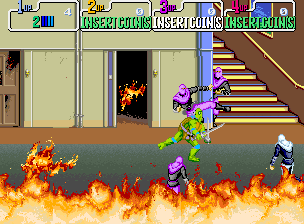
|
| rating |   74.3% after 260 votes |
| clones | Teenage Mutant Hero Turtles (UK 2 Players, set 1) Teenage Mutant Hero Turtles (UK 2 Players, set 2) Teenage Mutant Hero Turtles (UK 4 Players) Teenage Mutant Ninja Turtles (Japan 2 Players) Teenage Mutant Ninja Turtles (Japan 4 Players) Teenage Mutant Ninja Turtles (Oceania 2 Players) Teenage Mutant Ninja Turtles (US 4 Players, set 1) Teenage Mutant Ninja Turtles (US 4 Players, set 2) |


display
| colour emulation | good |
| palette | 1024 |
| display type | raster |
| orientation | horizontal |
| resolution | 304x224 |
| frequency | 60.000000Hz |
sound
| sound emulation | good |
| channels | mono |
controls
| players | 4 |
| nplayers | 4P sim |
| controls | 8 way joystick |
| buttons | 2 |
| coin slots | 4 |
hardware
| cpu | 68000 @ 8MHz |
| cpu | Z80 @ 3.579545MHz |
| audio | YM2151 @ 3.579545MHz |
| audio | K007232 @ 3.579545MHz |
| audio | UPD7759 @ 0.64MHz |
| audio | Samples |
data
| version added | .033b06 | ||||||||||||||||||||||||||||||||||||||||||||||||||||||||||||||||||||||||||||||||||||||||||||||||||||||
| last change(s) | .108 .103u3 | ||||||||||||||||||||||||||||||||||||||||||||||||||||||||||||||||||||||||||||||||||||||||||||||||||||||
| roms |
|
cabinet art


additional information
| info | 0.37b15 [Alex Simmons] 0.33b1 [Alex Pasadyn] Artwork available WIP:
Other Emulators:
Genre: Comedy Year: USA 1990 Director: Steve Barron Studio: 20th Century-Fox Cast: Judith Hoag, Elias Koteas, Joch Pals, Michelan Sisti, Leif Tilden, David Forman Recommended Games: Romset: 4257 kb / 16 files / 1.75 zip |
| history | Teenage Mutant Ninja Turtles (c) 1989 Konami. Between one and four players can choose to play either Leonardo (blue, katana blades); Raphael (red, sais); Michaelangelo (orange, nunchakas); or Donatello (purple, bo staff) as the infamous turtles fight against the might of Shredder's army to rescue April O'Neil and Splinter; before a final confrontation with their arch-enemies Krang and The Shredder. Turtles was a superb use of its license and perfectly captured the spirit of both the comic-book and cartoon series upon which it was based. New players could join the game at any time. - TECHNICAL - Game ID : GX963 Main CPU : 68000 (@ 8 Mhz) Sound CPU : Z80 (@ 3.579545 Mhz) Sound Chips : YM2151 (@ 3.579545 Mhz), K007232 (@ 3.579545 Mhz), UPD7759 (@ 640 Khz), Samples (@ 640 Khz) Screen orientation : Horizontal Video resolution : 304 x 224 pixels Screen refresh : 60.00 Hz Palette colors : 1024 Players : 4 Control : 8-way joystick Buttons : 2 (JUMP, ATTACK) - TRIVIA - The UK title for this game (as well as both the comics and cartoon series), "Teenage Mutant Hero Turtles", replaced the original 'ninja' of the title with the less threatening 'Hero'. This is because the Conservative British government of the time wouldn't allow ANY 'children's product' to include the word 'ninja' at any point during its content, arguing that to do so would encourage the children of this fine country to use violence against each other. This game is known in Japan as "Teenage Mutant Ninja Turtles - Super Kame Ninja". The Teenage Mutant Ninja Turtles were created by Kevin Eastman and Peter Laird in 1984 and published by Mirage Studios. The whole idea for the comic book (which was originally published in Black and White) came from the nickname 'Ninja Turtle' that one of the creators had when they were young. In 1987, Playmates Toys bought the rights of the characters to produce a line of Action Figures. That same year Playmates made a TV adaptation of the story for a 5-episode mini series which became a huge success. Two years later, the series went on full production and was aired on CBS stations from 1989 to 1996 (with brief hiatus in 1993-1994). The success of this 'Humanoid Action Animal' concept spawned (or shed some light on) many other comics, toys and TV shows such as Bucky O'Hare, Swat Kats, C.O.W. Boys of Moo Mesa, Street Sharks, Biker Mice from Mars among others; most of them became complete blunders. After the first series was cancelled other shows based on these characters appeared, such as, Ninja Turtles: The Next Mutation (Saban Productions, Live Action), Teenage Mutant Ninja Turtles and TMNT Fast-Forward. However, the 1980's craze never took off again. Konami hit the jackpot with this game. It was so successful that Konami went on a license-acquiring craze. They got the rights to many American (and some European) TV shows and Comic Books for home and arcade videogames with a quality so good that sometimes shadowed the original work. This game is mainly based in the first 5 episode mini-series. However, it contains some references to the original comic book. The opening scene is a mix between a scene in the TV show in which a building is raided by the TMNT to find for the first time the Technodrome and a scene of the comic book in which Shredder sets fire to April's building when he finds she's harboring the turtles (that scene was also taken for the movie). At the Parking Lot scene, there is a van that has the logo of TCRI. TCRI (or TGRI in the movie) was the company responsible for the mutagen; in the TV show, it was Shredder's invention. The first names of turtles; Michaelangelo, Raphael, Leonardo, and Donatello, are the names of Italian Renaissance artists who lived between 1386 and 1564. Three of those artists had full names which were respectively Michaelangelo Buonariti, Raphael Sanzio and Leonardo Da Vinci; but as for Donatello, that was his only name. There were several distinct versions of this game available in the arcade, but the 4-player dedicated cabinet was the most common by far. There were also 2-player versions, but they are much harder to come by. The TMNT dedicated cabinet was fairly large and had an over-sized control panel (to accommodate four players). The sides were decorated with full side-art showing April O'Neal and several of the turtles in a city scene. The marquee shows a city scene with all the turtles and a live action version of April O'Neal. Frankly they just should have drawn her instead of using a photograph, her hair is just awful. The control panel has a city scene similar to the one on the marquee and has four joysticks (one for each player), each of which is a different color. These machines all came equipped with 25'' open frame monitors, although you will sometimes run into one with a different size screen, these are almost always conversions of other titles. Moving on to the interior of the machine, the game itself runs on a JAMMA compatible circuit board. The board itself will plug into a JAMMA wiring harness, but it has a second harness to accommodate the controls for players three and four. The games "The Simpsons", "Sunset Riders", and "Bucky O'Hare" are fully compatible with this extended harness, and will plug directly into a TMNT cabinet without modification. One thing that you may notice is that the jump and attack buttons seem backwards of what they would logically be, but you get used to it quickly. In the ending epilogue, Konami spell Dimension X : 'Dimention X'. Soundtrack Releases : Konami Special Music Senryo-Bako Heisei 3 Nen-Ban (King Records - KICA-9005~8) (12/21/1990) - UPDATES - The US version is slightly different, it has the "Winners Don't Use Drugs" screen. - TIPS AND TRICKS - * When fighting in the sewer level, move your character as close as you can to the edge of the stone floor without falling into the water. If done correctly, no enemy in this level including the boss can touch you here as long as you remain on the floor's edge! * You can theoretically get unlimited points. Use the yellow guy's boomerang. Lead one yellow guy in such a way that he gets stuck at an object (fire hydrant or barrel) between you and him, aligned horizontally. He will try to move toward you, but he won't be able to move since the object is near him. Get close enough to him so that he starts throwing boomerangs. You can kill each one for (wow!) 1 point. * Killing most bosses consist of 3 strategies : They all consist of moving vertically towards the bosses. 1) Move vertically upwards, hit the boss, and move vertically downwards. Repeat until dead. Works well on Bebop. 2) Wait for the boss to move vertically down towards you, wait for him, hit him, and move vertically upwards. Repeat until he's dead. Works best on Rocksteady. Best results occur when you hit and run at the same time. 3) Wait for the boss to move vertically towards you. Jump over him, move through him and attack as you do this, keep moving. Repeat. Works well on the big robots. - SERIES -
|
| resource links | view in MAWS view in mini MAWS view in CAESAR view high score and replay at MARP view in Progetto EMMA (Italian) view game bugs at MAME Testers view driver bugs at MAME Testers view in arcade-history.com view in Games Database |
bookmarkable frame
|
2004-2010 MAWS all copyrights belong to their respective owners
