













To Draw Creatures From:



By the ox and the fox and the grizzly bear
The grumpy alligator and the hawk above
The sly old weasel and the turtle dove
- If caring for young, will defend to the death
- Generally averse to fire
| Camelopardel | Cave Lion | Getiet | Jaguar | Leopard |
| Lion | Lynx | Smilodon | Snow Cat | Snow Leopard |
| Tangtal | Tiger | Wooly Cheetah |
 Actions/Abilities/Traits: Basic Fantasy
Actions/Abilities/Traits: Basic Fantasy
Actions/Abilities/Traits: Basic Fantasy
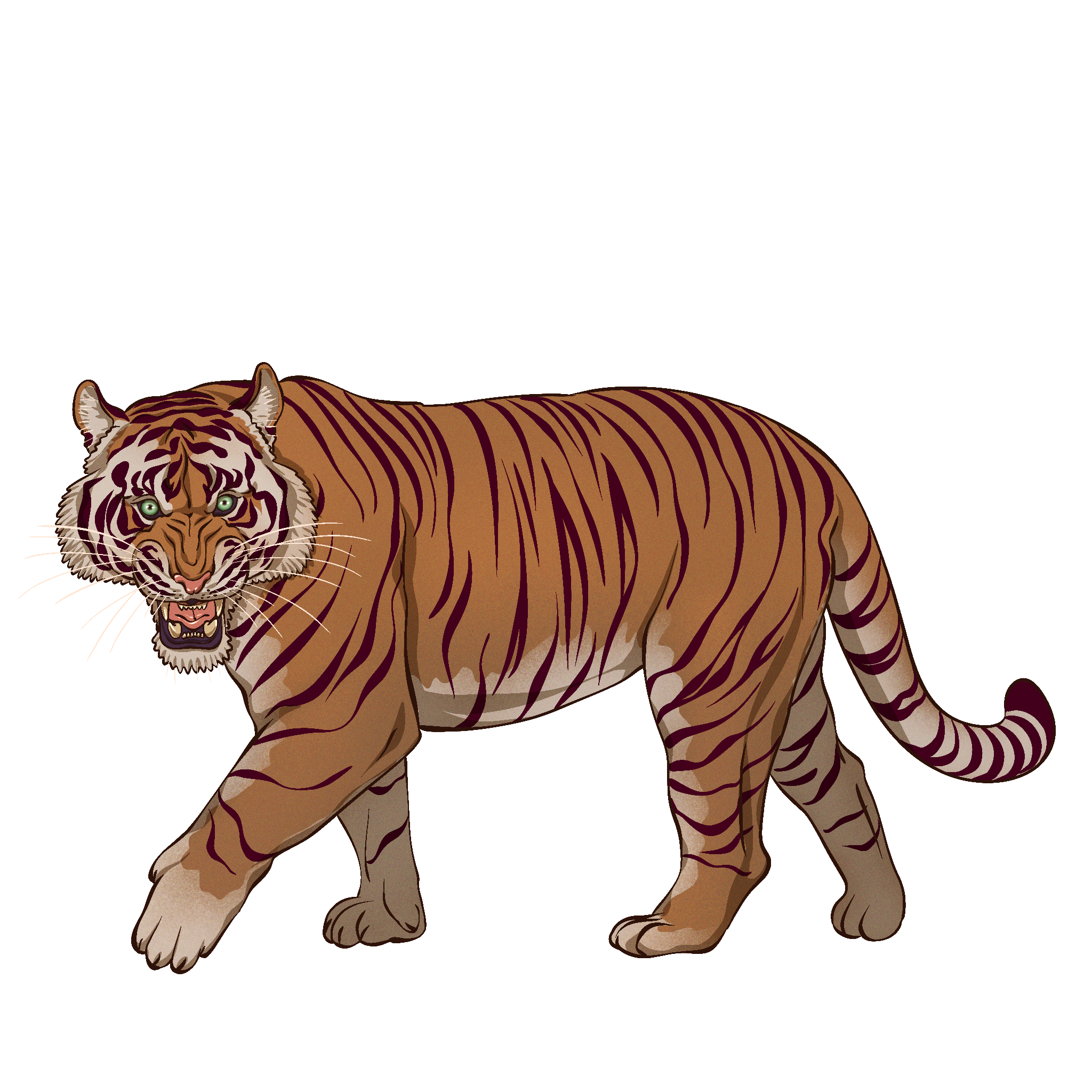
Large striped great cat with orange fur and dark vertical stripes
The tiger is among the largest great cat species, with male specimens averaging 10 feet in length (including about 2½ feet of tail) and weighing over 400 pounds. Females are smaller, averaging about 8 feet long and an average of about 275 pounds. Tigers are most recognizable for their dark vertical stripes on orange fur with a white underside. Tigers are apex predators and prefer prey such as deer and wild boar. They are territorial and generally solitary but social predators, requiring large contiguous areas of habitat to support their requirements for prey.
Actions/Abilities/Traits: Basic Fantasy
Actions/Abilities/Traits: D&D 5e
Actions/Abilities/Traits: D&D 5e
This powerful feline predator moves with a deadly grace, its reddish-orange fur slashed with black stripes.
Actions/Abilities/Traits: D&D 5e
Actions/Abilities/Traits: OSRIC
Actions/Abilities/Traits: OSRIC
Large striped great cat with orange fur and dark vertical stripes
Tigers are large, carnivorous and very cunning cats ranging from tropical climes to subarctic tundra. Tigers are ruthless and efficient predators, often hunting in pairs or family groups, surrounding their prey and attacking as one. Tigers can climb trees as easily as walking on the ground, leap 40-ft to attack from hiding, move silently at quarter speed in natural settings, and spring upwards 10-ft. Tigers attack with a claw-claw-bite routine. If both claw attacks are successful the tiger has grabbed its victim and gains two additional attacks at +4 "to hit" from its powerful rear legs for 1d6+2 points of damage each. There is a 25% chance a tiger met in its lair will have 1d3 cubs. In such a case, the tiger will fight to the death to defend them. When not defending its young, a tiger generally avoids contact with humans and demi-humans.
Actions/Abilities/Traits: OSRIC
Actions/Abilities/Traits: Pathfinder 1e
Actions/Abilities/Traits: Pathfinder 1e
Actions/Abilities/Traits: Pathfinder 1e





grasslands, savanna
uncommon

hills, grasslands
uncommon

forest
rare

hills, forest
rare

jungle
uncommon

wetlands, swamp
rare





This powerful feline predator moves with a deadly grace, its reddish-orange fur slashed with black stripes.
Large striped great cat with orange fur and dark vertical stripes
The tiger is among the largest great cat species, with male specimens averaging 10 feet in length (including about 2½ feet of tail) and weighing over 400 pounds. Females are smaller, averaging about 8 feet long and an average of about 275 pounds. Tigers are most recognizable for their dark vertical stripes on orange fur with a white underside. Tigers are apex predators and prefer prey such as deer and wild boar. They are territorial and generally solitary but social predators, requiring large contiguous areas of habitat to support their requirements for prey.
Cautious hunters that usually avoid combat with humans unless starving or cornered. Great cats may be playful, but are quick to anger. They remain outdoors, rarely venturing deep underground.
Large striped great cat with orange fur and dark vertical stripes
Tigers are large, carnivorous and very cunning cats ranging from tropical climes to subarctic tundra. Tigers are ruthless and efficient predators, often hunting in pairs or family groups, surrounding their prey and attacking as one. Tigers can climb trees as easily as walking on the ground, leap 40-ft to attack from hiding, move silently at quarter speed in natural settings, and spring upwards 10-ft. Tigers attack with a claw-claw-bite routine. If both claw attacks are successful the tiger has grabbed its victim and gains two additional attacks at +4 "to hit" from its powerful rear legs for 1d6+2 points of damage each. There is a 25% chance a tiger met in its lair will have 1d3 cubs. In such a case, the tiger will fight to the death to defend them. When not defending its young, a tiger generally avoids contact with humans and demi-humans.

Illustrated Bestiary
 (13)
(13)


 (12)
(12)
Monstrosities Swords & Wizardry
Angry Golem D&D 5e
Pathfinder 1e Bestiary 1 Pathfinder
Critter Cache: Animals And Beasts D&D 4e
Scruffy Grognard's Monstrous Manual D&D 2e
Hacklopedia Of Beasts Hackmaster v5
Hacklopedia Of Beasts Vol 1 Hackmaster
QUERP Bestiary QUERP
Mystara Adversary Compendium I Dragon Age
Adventures Dark And Deep Adventures Dark And Deep
Lairs And Encounters Adventurer, Conqueror, King