



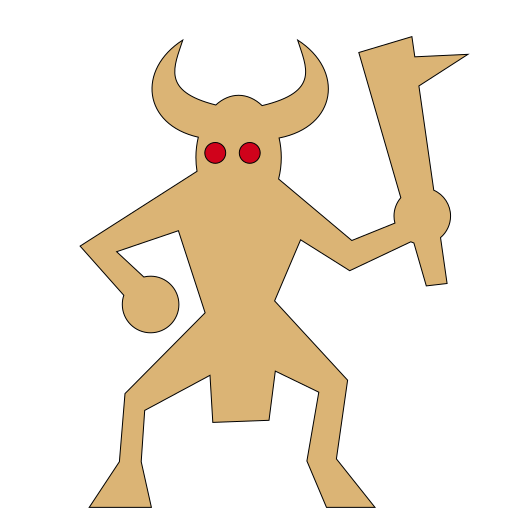










To Draw Creatures From:



You're almost human
- Humanoid creatures reason and act much like humans. They typically stand upright and have two arms and two legs.
 Actions/Abilities/Traits: Basic Fantasy
Actions/Abilities/Traits: Basic Fantasy
Actions/Abilities/Traits: Basic Fantasy
Grotesque humanoids bent on war and domination
Orcs are grotesque humanoids bent on war and domination. They have lupine ears, reddish eyes, truncated, upturned noses, and black hair (but very little body hair). An adult male orc is a little over 6 feet tall and weighs about 210 pounds; females are slightly smaller. Orcs prefer wearing vivid colors that many humans would consider unpleasant, such as blood red, mustard yellow, yellow-green, and deep purple. They utilize all manner of weapons and armor scavenged from battlefields. Orcs have Darkvision to a range of 60'. They suffer a -1 attack penalty in bright sunlight or within the radius of a spell causing magical light. They speak their own rough and simple language, but many also speak some common or goblin.
Actions/Abilities/Traits: Basic Fantasy
Actions/Abilities/Traits: D&D 5e
Actions/Abilities/Traits: D&D 5e
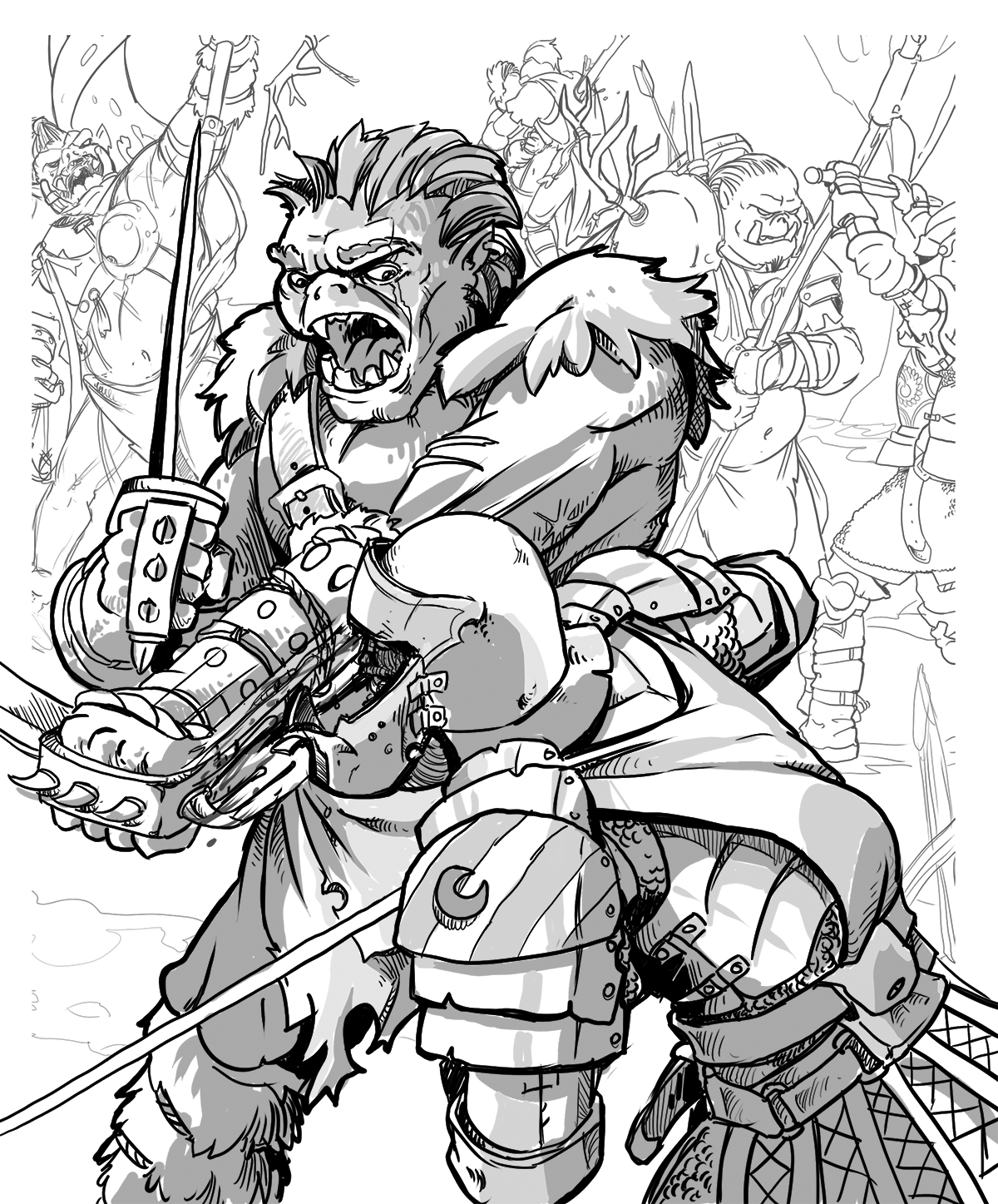
This barbaric humanoid bears ragged equipment and armor in sullen colors. It has coarse body hair and a stooped posture like some primitive man but with a grayish-green skin tone and bestial facial features beneath a black hood. Burning red eyes peer below a low, sloping brow, just above a flattened nose, and prominent tusk-like teeth.
Orcs are savage raiders and pillagers with stooped postures, low foreheads, and piggish faces with prominent lower canines that resemble tusks.
Gruumsh One-Eye
Orcs worship Gruumsh, the mightiest of the orc deities and their creator. The orcs believe that in ancient days, the gods gathered to divide the world among their followers. When Gruumsh claimed the mountains, he learned they had been taken by the dwarves. He laid claim to the forests, but those had been settled by the elves. Each place that Gruumsh wanted had already been claimed. The other gods laughed at Gruumsh, but he responded with a furious bellow. Grasping his mighty spear, he laid waste to the mountains, set the forests aflame, and carved great furrows in the fields. Such was the role of the orcs, he proclaimed, to take and destroy all that the other races would deny them. To this day, the orcs wage an endless war on humans, elves, dwarves, and other folk.
Orcs hold a particular hatred for elves. The elven god Corellon Larethian half-blinded Gruumsh with a well-placed arrow to the orc god's eye. Since then, the orcs have taken particular joy in slaughtering elves. Turning his injury into a baleful gift, Gruumsh grants divine might to any champion who willingly plucks out one of its eyes in his honor.
Tribes like Plagues
Orcs gather in tribes that exert their dominance and satisfy their bloodlust by plundering villages, devouring or driving off roaming herds, and slaying any humanoids that stand against them. After savaging a settlement, orcs pick it clean of wealth and items usable in their own lands. They set the remains of villages and camps ablaze, then retreat whence they came, their bloodlust satisfied.
Ranging Scavengers
Their lust for slaughter demands that orcs dwell always within striking distance of new targets. As such, they seldom settle permanently, instead converting ruins, cavern complexes, and defeated foes' villages into fortified camps and strongholds. Orcs build only for defense, making no innovation or improvement to their lairs beyond mounting the severed body parts of their victims on spiked stockade walls or pikes jutting up from moats and trenches.
When an existing territory is depleted of food, an orc tribe divides into roving bands that scout for choice hunting grounds. When each party returns, it brings back trophies and news of targets ripe for attack, the richest of which is chosen. The tribe then sets out en masse to carve a bloody path to its new territory.
On rare occasions, a tribe's leader chooses to hold onto a particularly defensible lair for decades. The orcs of such a tribe must range far across the countryside to sate their appetites.
Leadership and Might
Orc tribes are mostly patriarchal, flaunting such vivid or grotesque titles as Many-Arrows, Screaming Eye, and Elf Ripper. Occasionally, a powerful war chief unites scattered orc tribes into a single rampaging horde, which runs roughshod over other orc tribes and humanoid settlements from a position of overwhelming strength.
Strength and power are the greatest of orcish virtues, and orcs embrace all manner of mighty creatures in their tribes. Rejecting notions of racial purity, they proudly welcome ogres, trolls, half-orcs, and orogs into their ranks. As well, orcs respect and fear the size and power of evil giants, and often serve them as guards and soldiers.
Orc Crossbreeds
Luthic, the orc goddess of fertility and wife of Gruumsh, demands that orcs procreate often and indiscriminately so that orc hordes swell generation after generation. The orcs' drive to reproduce runs stronger than any other humanoid race, and they readily crossbreed with other races. When an orc procreates with a non-orc humanoid of similar size and stature (such as a human or a dwarf), the resulting child is either an orc or a half-orc. When an orc produces young with an ogre, the child is a half-ogre of intimidating strength and brutish features called an ogrillon.
Actions/Abilities/Traits: D&D 5e
Actions/Abilities/Traits: D&D 5e (Orc Blade of Ilneval)
Actions/Abilities/Traits: D&D 5e (Orc Blade of Ilneval)
Ilneval is Gruumsh's battle captain, a devious strategist who directs Gruumsh's soldiers with boldness. Among orcs, warriors that venerate Ilneval emulate their deity. Such orcs learn to command their fellows in ways that are unpredictable but help to ensure victory.
The wisest among these leaders gain Ilneval's favor and rise to become known as blades, tactical experts who advise their chief in matters of war. Blades lead from the front, wading into combat fearlessly while barking orders at lesser soldiers. A blade knows how to use orcish ferocity to best advantage, and helps the ordinary warriors to work together against their adversaries.
Actions/Abilities/Traits: D&D 5e (Orc Blade of Ilneval)
Actions/Abilities/Traits: D&D 5e (Orc Claw of Luthic)
Actions/Abilities/Traits: D&D 5e (Orc Claw of Luthic)
Luthic is Gruumsh's wife and the paragon of maternity to all orcs. She is the Cave Mother, a fierce dweller in the darkness who raises new broods of orcs to be vicious and strong. Her symbol is the cave bear, and orc females raise such bears alongside orc whelps. Females particularly attracted to Luthic grow long nails and lacquer them, learning to use these claws as weapons much as Luthic uses her own.
Orc females devoted to Luthic are in charge of fortifying and maintaining an orc stronghold. They help to guarantee the survival of the tribe, and most are skilled in the healing arts. The most powerful among Luthic's disciples are the claws of Luthic, which can use the Cave Mother's magic to heal, protect, and curse.
Actions/Abilities/Traits: D&D 5e (Orc Claw of Luthic)
Actions/Abilities/Traits: D&D 5e (Orc Eye of Gruumsh)
Actions/Abilities/Traits: D&D 5e (Orc Eye of Gruumsh)
When an orc slays an elf in Gruumsh's name and offers the corpse of its foe as a sacrifice to the god of slaughter, an aspect of the god might appear. This aspect demands an additional sacrifice: one of the orc's eyes, symbolizing the loss Gruumsh suffered at the hands of his greatest enemy, Corellon Larethian.
If the orc plucks out one of its eyes, Gruumsh might grant the orc spellcasting ability and special favor, along with the right to call itself an Eye of Gruumsh. When not using their auguries to advise their war chiefs, these savage devotees of the god of slaughter hurl themselves into battle, their weapons stained with blood.
Actions/Abilities/Traits: D&D 5e (Orc Eye of Gruumsh)
Actions/Abilities/Traits: D&D 5e (Orc Hand of Yurtrus)
Actions/Abilities/Traits: D&D 5e (Orc Hand of Yurtrus)
Yurtrus is the orc god of death and disease. He is a horrifying abomination covered in rot and infection, except for his perfect, smooth white hands.
Orc priests that oversee the line between life and death are known by the others in the tribe as hands of Yurtrus. They dwell on the fringes of an orc lair, usually communing with other orcs through the auspices of those who follow Luthic. The hands of Yurtrus wear pale gloves made of the bleached skin of other humanoids (preferably elves), symbolizing their connection with Yurtrus, and are sometimes called "white hands" as a result.
Every orc knows that the hands of Yurtrus are the tribe's gateway to the ancestors. Orcs who die having served the tribe well go on to rituals meant to send them to Gruumsh's realm.
As befits followers of a god who doesn't speak, hands of Yurtrus remove their tongues to emulate their deity, for a reason similar to why an eye of Gruumsh puts out one of its eyes.
Actions/Abilities/Traits: D&D 5e (Orc Hand of Yurtrus)
Actions/Abilities/Traits: D&D 5e (Orc Nurtured One of Yurtrus)
Actions/Abilities/Traits: D&D 5e (Orc Nurtured One of Yurtrus)
When plague strikes a tribe, the hands of Yurtrus isolate the sick. The priests then minister to those who can be saved but not healed. The hands cultivate the sickness of these nurtured ones, turning them into instruments of defense and weapons of war. When orcs go to battle, a band of nurtured ones might charge in first-to give themselves up while softening up the enemy by spreading Yurtrus's vile blessing in its ranks.
Actions/Abilities/Traits: D&D 5e (Orc Nurtured One of Yurtrus)
Actions/Abilities/Traits: D&D 5e (Orc Red Fang of Shargaas)
Actions/Abilities/Traits: D&D 5e (Orc Red Fang of Shargaas)
Shargaas is the orc deity of deep darkness and sneakiness, a murderous god who hates anything that lives that isn't an orc. Orcs consider Shargaas to be a divinity suited to pariahs and weaklings, all of them unfit for true roles in tribal life. These outsiders live in the most remote, deepest parts of the tribe's domain.
The elite among Shargaas's followers are the assassins and thieves that follow the cult of the Red Fang. They perform assassinations, stealthy raids, and other covert operations on the tribe's behalf. They rely on a mix of intense training and magic granted to them by Shargaas.
Most Red Fang enclaves keep and nurture giant bats, creatures that are sacred to Shargaas. Red Fangs ride these bats into battle or on secret raids and assassination missions into enemy territory.
Actions/Abilities/Traits: D&D 5e (Orc Red Fang of Shargaas)
Actions/Abilities/Traits: D&D 5e (Orc War Chief)
Actions/Abilities/Traits: D&D 5e (Orc War Chief)
The war chief of an orc tribe is its strongest and most cunning member. The reign of a war chief lasts only as long as it commands the fear and respect of other tribe members, whose bloodlust must be regularly satisfied lest the chief appear weak.
Scions of Slaughter
Gruumsh bestows special blessings upon war chiefs who prove themselves in battle time and again, imbuing them with slivers of his savagery. A war chief so blessed finds that his weapons cut deeper into his enemies, allowing him to inflict more carnage.
King Obould Many-Arrows
King Obould of the Many-Arrows tribe is a legend among the orc war chiefs of the Forgotten Realms, and he is the most famous orc chief in the history of the D&D game.
Smarter and more intuitive than most of his kind, Obould slew his chieftain to take control of his tribe. Skilled in the arts of war and renowned for his violent temper, Obould proved himself a fierce opponent in battle time and again. Over the years, he subsumed other orc tribes into his own, until he commanded a horde of thousands.
Obould leveraged his strength and influence to carve out a kingdom for himself in the Spine of the World, a mountain range overlooking numerous dwarven, human, and elven strongholds.
After years of bloody conflict with his more civilized neighbors, Obould did the unthinkable and brokered a peace treaty with his enemies. This treaty confused many of the orcs under Obould's command. It was either a clever ploy by Obould to buy time while he strengthened his army for a final, decisive sweep across the Savage Frontier, or it was a troubling sign that Obould had forsaken the ways of Gruumsh and needed to be destroyed.
He worked his serrated long knife savagely, tearing out the king's throat to the howls of approval from his legions. The ferocious orc didn't stop there, digging and ripping the blade back and forth unrelentingly until he took the head off the dwarf king's shoulders.
Actions/Abilities/Traits: D&D 5e (Orc War Chief)
Actions/Abilities/Traits: OSRIC
Actions/Abilities/Traits: OSRIC
Grotesque humanoids bent on war and domination
Orcs are fiercely tribal creatures, and will make war upon any neighbouring tribe if possible. They will only unite with other tribes if there is an external force strong enough to be able to control the leaders of the tribes. Orcs are cruel, spiteful creatures and detest elves. They will attack elves on sight. They are known to take slaves of the other races, however. Orcs speak goblin and hobgoblin in addition to their own foul tongue. Most lairs will be found underground, and those found above ground will consist of simple huts, typically with some kind of defence (ditch, moat, crude walls, etc). Description: Orcs are filthy, disgusting creatures with a brown or brownish-green coloured skin tone. Their hair is a nest of black or dark brown. They wear rusty and misused armour. They have an average lifespan of 40 years.
Actions/Abilities/Traits: OSRIC
Actions/Abilities/Traits: Pathfinder 1e
Actions/Abilities/Traits: Pathfinder 1e
Actions/Abilities/Traits: Pathfinder 1e




forest
uncommon
hills, forest
uncommon
taiga
rare
mountain, montane forest
uncommon
mountain, cave
rare
civilized, farmland
rare
Gehenna 1
uncommon
Gehenna 2
uncommon
Gehenna 3
rare
Gehenna 4
rare
Gehenna 5
rare





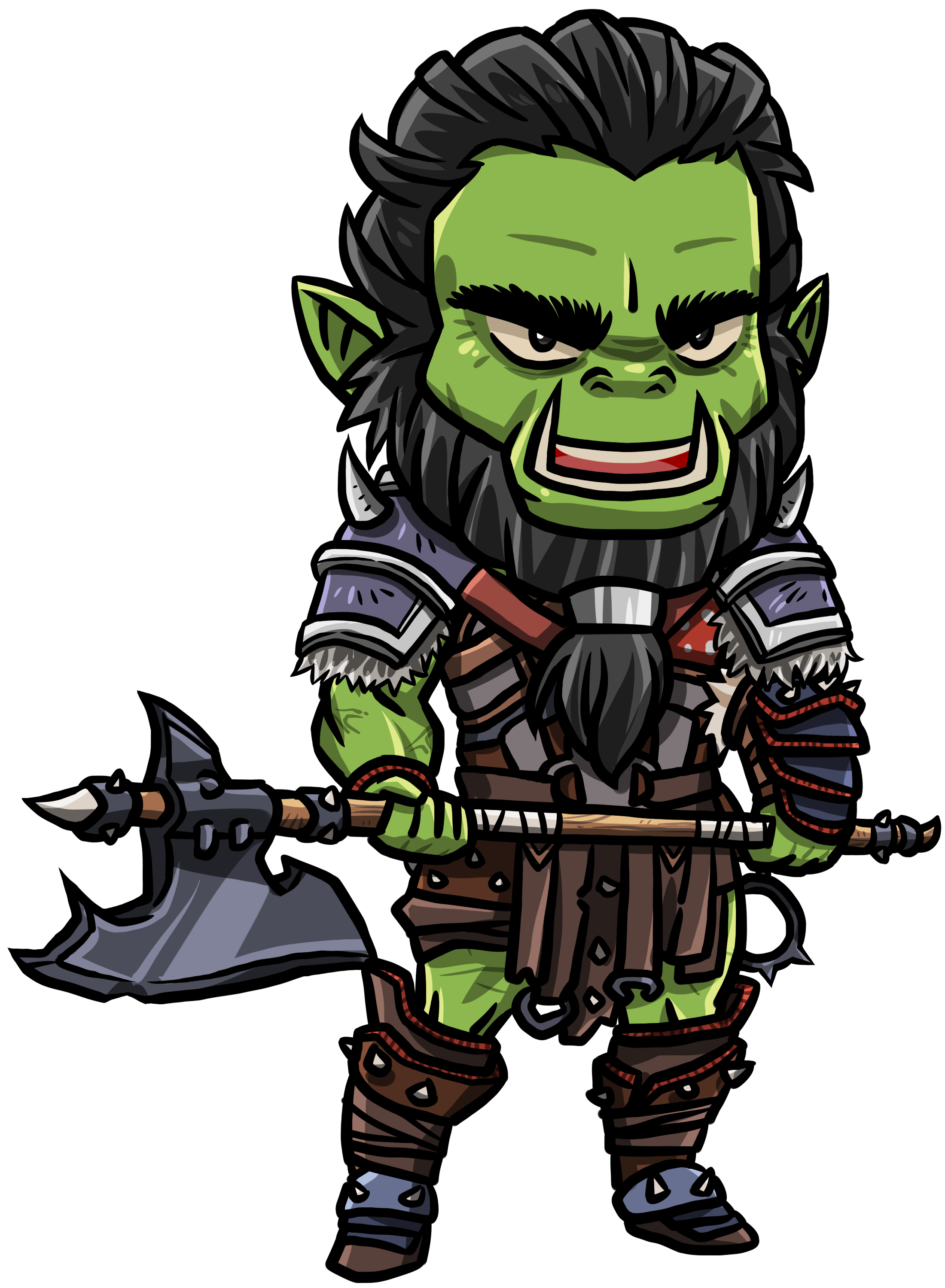
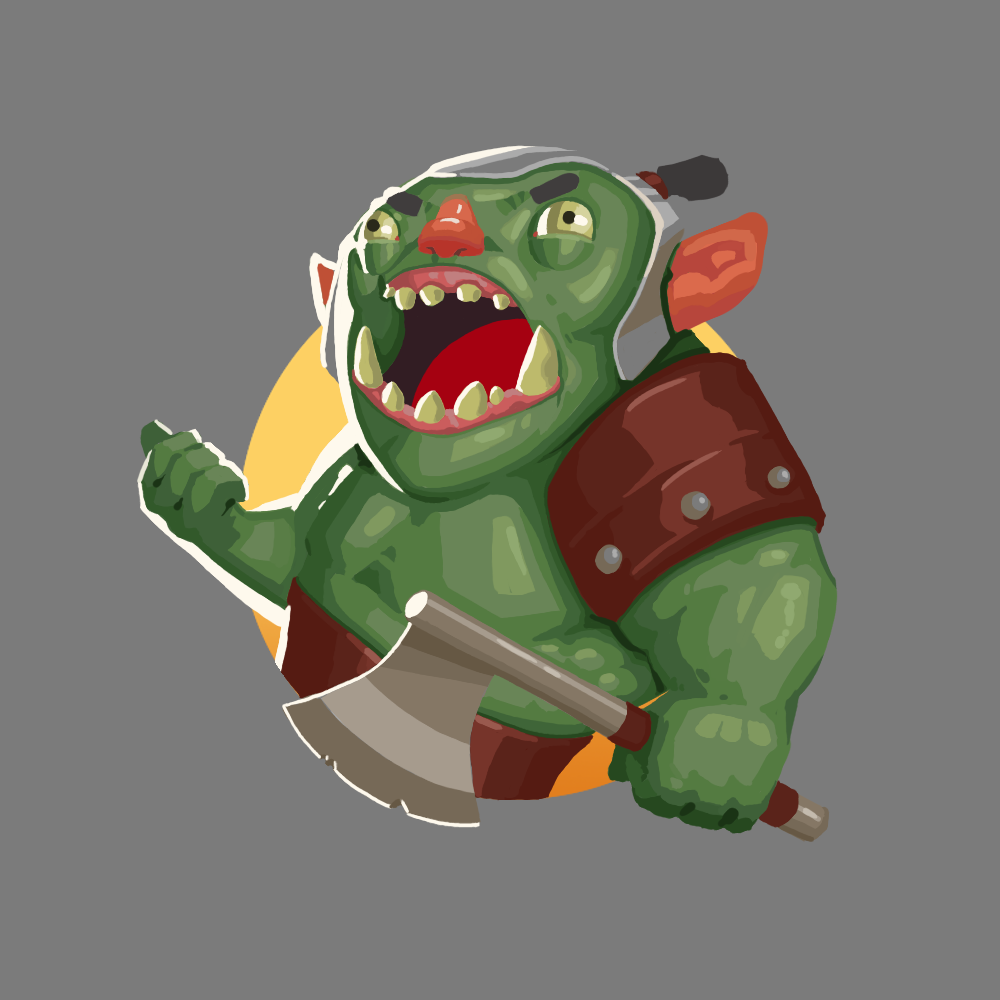
This barbaric humanoid bears ragged equipment and armor in sullen colors. It has coarse body hair and a stooped posture like some primitive man but with a grayish-green skin tone and bestial facial features beneath a black hood. Burning red eyes peer below a low, sloping brow, just above a flattened nose, and prominent tusk-like teeth.
Orcs are savage raiders and pillagers with stooped postures, low foreheads, and piggish faces with prominent lower canines that resemble tusks.
Gruumsh One-Eye
Orcs worship Gruumsh, the mightiest of the orc deities and their creator. The orcs believe that in ancient days, the gods gathered to divide the world among their followers. When Gruumsh claimed the mountains, he learned they had been taken by the dwarves. He laid claim to the forests, but those had been settled by the elves. Each place that Gruumsh wanted had already been claimed. The other gods laughed at Gruumsh, but he responded with a furious bellow. Grasping his mighty spear, he laid waste to the mountains, set the forests aflame, and carved great furrows in the fields. Such was the role of the orcs, he proclaimed, to take and destroy all that the other races would deny them. To this day, the orcs wage an endless war on humans, elves, dwarves, and other folk.
Orcs hold a particular hatred for elves. The elven god Corellon Larethian half-blinded Gruumsh with a well-placed arrow to the orc god's eye. Since then, the orcs have taken particular joy in slaughtering elves. Turning his injury into a baleful gift, Gruumsh grants divine might to any champion who willingly plucks out one of its eyes in his honor.
Tribes like Plagues
Orcs gather in tribes that exert their dominance and satisfy their bloodlust by plundering villages, devouring or driving off roaming herds, and slaying any humanoids that stand against them. After savaging a settlement, orcs pick it clean of wealth and items usable in their own lands. They set the remains of villages and camps ablaze, then retreat whence they came, their bloodlust satisfied.
Ranging Scavengers
Their lust for slaughter demands that orcs dwell always within striking distance of new targets. As such, they seldom settle permanently, instead converting ruins, cavern complexes, and defeated foes' villages into fortified camps and strongholds. Orcs build only for defense, making no innovation or improvement to their lairs beyond mounting the severed body parts of their victims on spiked stockade walls or pikes jutting up from moats and trenches.
When an existing territory is depleted of food, an orc tribe divides into roving bands that scout for choice hunting grounds. When each party returns, it brings back trophies and news of targets ripe for attack, the richest of which is chosen. The tribe then sets out en masse to carve a bloody path to its new territory.
On rare occasions, a tribe's leader chooses to hold onto a particularly defensible lair for decades. The orcs of such a tribe must range far across the countryside to sate their appetites.
Leadership and Might
Orc tribes are mostly patriarchal, flaunting such vivid or grotesque titles as Many-Arrows, Screaming Eye, and Elf Ripper. Occasionally, a powerful war chief unites scattered orc tribes into a single rampaging horde, which runs roughshod over other orc tribes and humanoid settlements from a position of overwhelming strength.
Strength and power are the greatest of orcish virtues, and orcs embrace all manner of mighty creatures in their tribes. Rejecting notions of racial purity, they proudly welcome ogres, trolls, half-orcs, and orogs into their ranks. As well, orcs respect and fear the size and power of evil giants, and often serve them as guards and soldiers.
Orc Crossbreeds
Luthic, the orc goddess of fertility and wife of Gruumsh, demands that orcs procreate often and indiscriminately so that orc hordes swell generation after generation. The orcs' drive to reproduce runs stronger than any other humanoid race, and they readily crossbreed with other races. When an orc procreates with a non-orc humanoid of similar size and stature (such as a human or a dwarf), the resulting child is either an orc or a half-orc. When an orc produces young with an ogre, the child is a half-ogre of intimidating strength and brutish features called an ogrillon.
Grotesque humanoids bent on war and domination
Orcs are grotesque humanoids bent on war and domination. They have lupine ears, reddish eyes, truncated, upturned noses, and black hair (but very little body hair). An adult male orc is a little over 6 feet tall and weighs about 210 pounds; females are slightly smaller. Orcs prefer wearing vivid colors that many humans would consider unpleasant, such as blood red, mustard yellow, yellow-green, and deep purple. They utilize all manner of weapons and armor scavenged from battlefields. Orcs have Darkvision to a range of 60'. They suffer a -1 attack penalty in bright sunlight or within the radius of a spell causing magical light. They speak their own rough and simple language, but many also speak some common or goblin.
Ugly, bad-tempered, animalistic humanoids who live underground and are active at night. Sadistic bullies who hate other living creatures and delight in killing.
Grotesque humanoids bent on war and domination
Orcs are fiercely tribal creatures, and will make war upon any neighbouring tribe if possible. They will only unite with other tribes if there is an external force strong enough to be able to control the leaders of the tribes. Orcs are cruel, spiteful creatures and detest elves. They will attack elves on sight. They are known to take slaves of the other races, however. Orcs speak goblin and hobgoblin in addition to their own foul tongue. Most lairs will be found underground, and those found above ground will consist of simple huts, typically with some kind of defence (ditch, moat, crude walls, etc). Description: Orcs are filthy, disgusting creatures with a brown or brownish-green coloured skin tone. Their hair is a nest of black or dark brown. They wear rusty and misused armour. They have an average lifespan of 40 years.

Miko Arc
Justin Nichol
Mariana Ruiz Villarreal
 (26)
(26)


 (34)
(34)
The Monsters Know What They're Doing Dungeons And Dragons
The Monsters Know What They're Doing 2 (moar) Dungeons And Dragons
Angry Golem D&D 5e
OSE Encounter Activity Tables Any
Pathfinder 1e Bestiary 1 Pathfinder
Pathfinder 2e Bestiary 1 Pathfinder
Monster Codex Pathfinder
Monsters Of Porphyra v1 Pathfinder
Tome Of Horrors Complete Pathfinder
The Daily Bestiary Pathfinder
Classic Monsters Revisited Pathfinder
Lost Lands: Mountains Of Madness Pathfinder
Tome Of Horrors 2018 D&D 5e
Flee, Mortals D&D 5e
Ultimate Bestiary: Revenge Of The Horde D&D 5e
Volo's Guide To Monsters D&D 5e
Limitless Monsters D&D 5e
Monster Monday D&D 5e
Monsters Of The Underworld D&D 5e
Monster Ecology Anthology D&D 5e
Dungeons And Dragons Essentials: Monster Vault D&D 4e
Monster Vault: Threats To The Nentir Vale D&D 4e
Dragon Magazine D&D 2e/3e
Scruffy Grognard's Monstrous Manual D&D 2e
AD&D Monster Manual AD&D 1e
13th Age Bestiary 13th Age
Hacklopedia Of Beasts Hackmaster v5
Dragonbane Bestiary Dragonbane
Old World Bestiary Warhammer
QUERP Bestiary QUERP
Mystara Adversary Compendium I Dragon Age
Baby Bestiary 2 Any