












To Draw Creatures From:



You're almost human
- Humanoid creatures reason and act much like humans. They typically stand upright and have two arms and two legs.
They pounce least expected
Jackal: Small, hunt in pairs. Slender and shorter legs. Timid.
| Anpur | Bouda | Gnoll | Hyaenodon | Hyena |
| Werehyena |
That you have to fall
In with the pack wherever they run?
 Actions/Abilities/Traits: Basic Fantasy
Actions/Abilities/Traits: Basic Fantasy
Actions/Abilities/Traits: Basic Fantasy
Hyena-headed, evil humanoids that wander in loose tribes
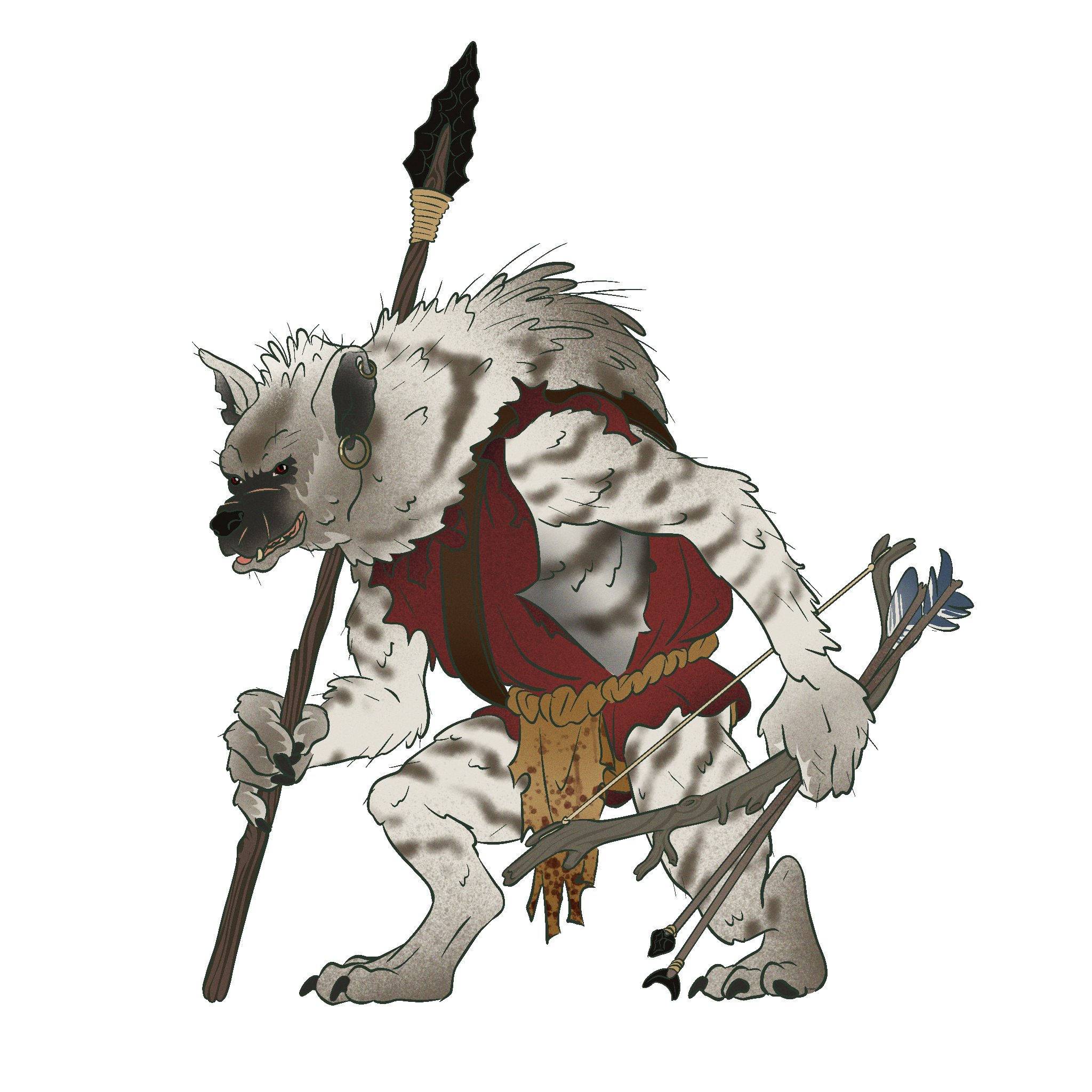
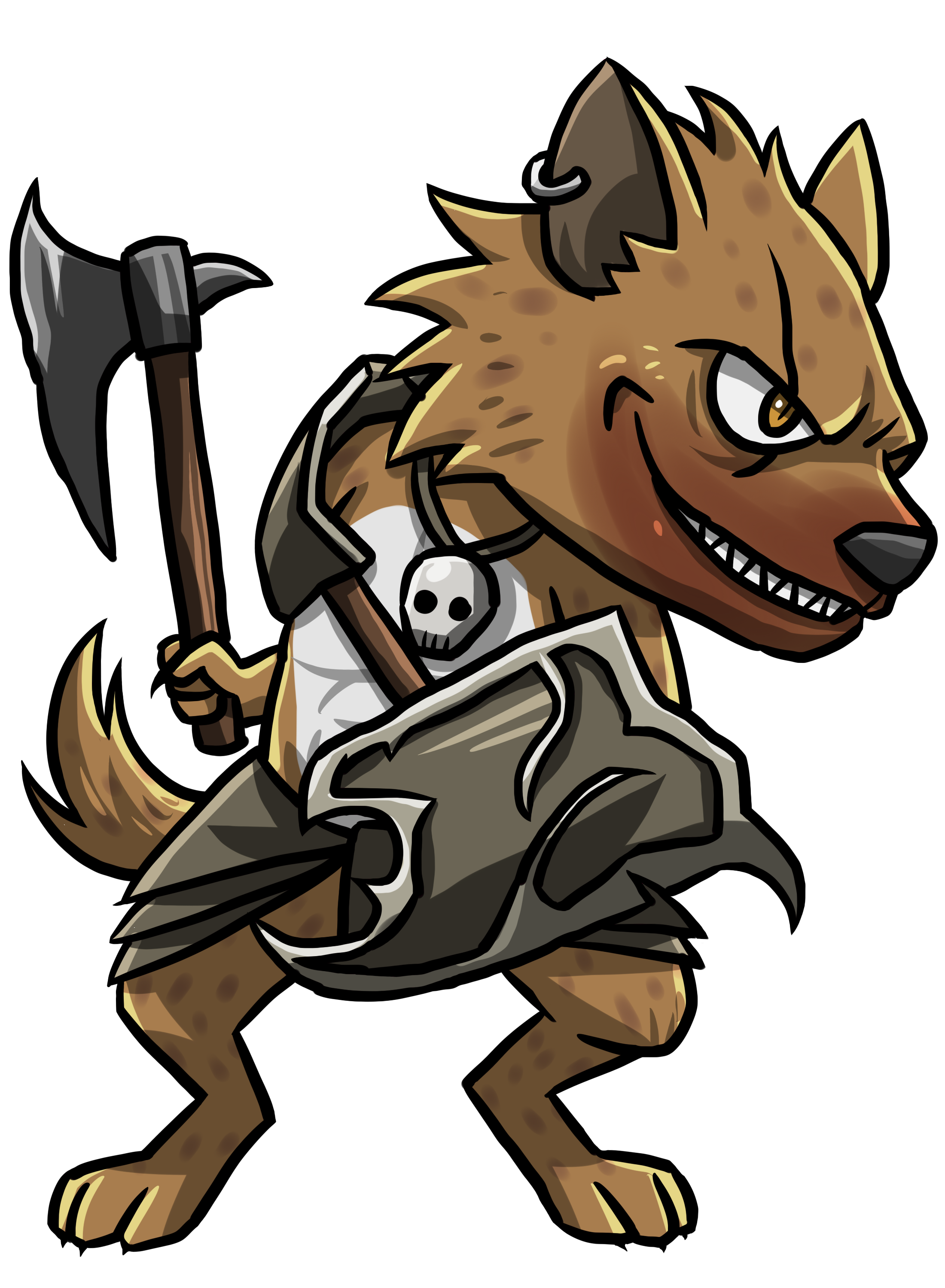
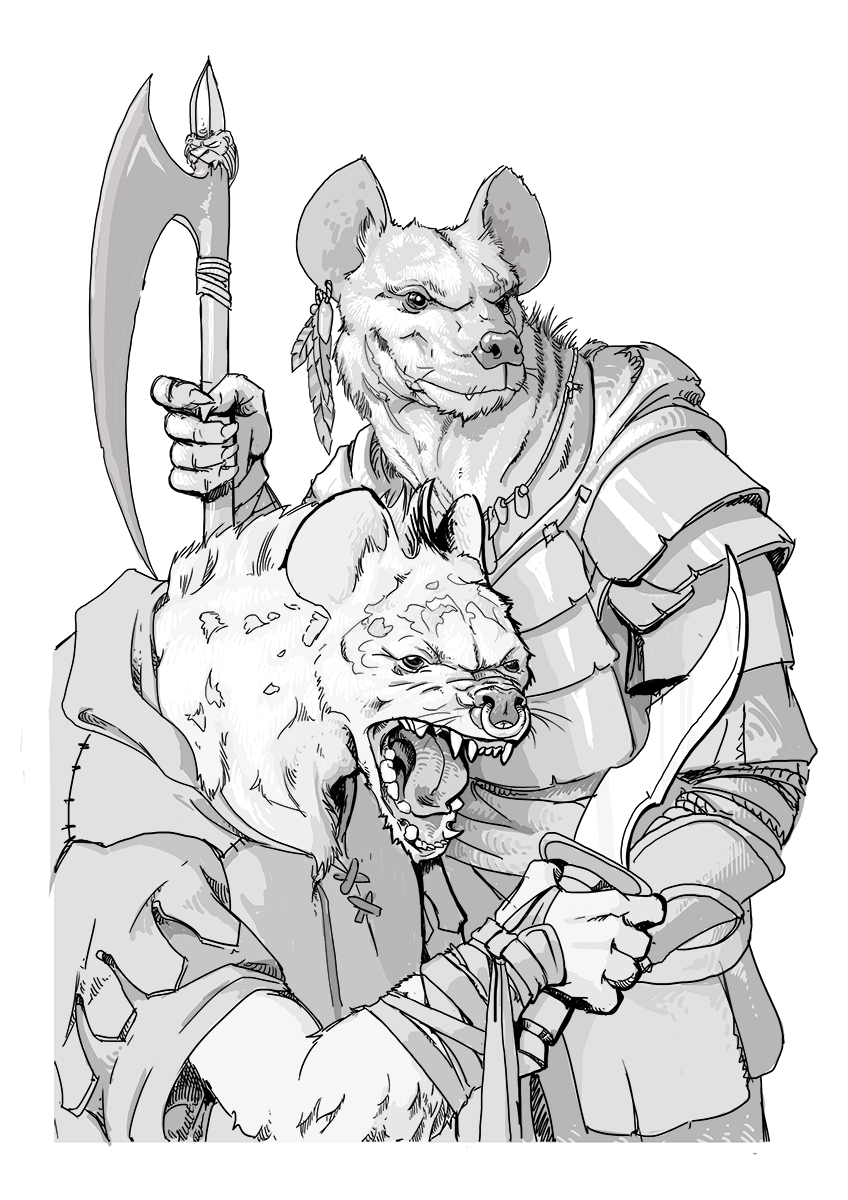
Gnolls are hyena-headed, evil humanoids that wander in loose tribes. Most gnolls have dirty yellow or reddish-brown fur. An adult male gnoll is about 7½ feet tall and weighs 300 pounds. Gnolls are nocturnal, and have Darkvision with a 30' range. They are cruel carnivores, preferring intelligent creatures for food because they scream more. They show little discipline when fighting unless they have a strong leader.
Actions/Abilities/Traits: Basic Fantasy
Actions/Abilities/Traits: D&D 5e
Actions/Abilities/Traits: D&D 5e
Pack warriors make up the bulk of a gnoll tribe's fighting force, and while individually they are vicious and lethal, when attacking en masse they are a relentless horde.
In combat they are fearless, favoring numbers and ferocity as their primary (if somewhat rudimentary) tactic. A good war chieftain can go a long way in organizing this pack mob mentality into victory on the battlefield.
Gnolls are feral humanoids that attack settlements along the frontiers and borderlands of civilization without warning, slaughtering their victims and devouring their flesh.
Demonic Origin
The origin of the gnolls traces back to a time when the demon lord Yeenoghu found his way to the Material Plane and ran amok. Packs of ordinary hyenas followed in his wake, scavenging the demon lord's kills. Those hyenas were transformed into the first gnolls, parading after Yeenoghu until he was banished back to the Abyss. The gnolls then scattered across the face of the world, a dire reminder of demonic power.
Nomadic Destroyers
Gnolls are dangerous because they strike at random. They emerge from the wilderness, plunder and slaughter, then move elsewhere. They attack like a plague of locusts, pillaging settlements and leaving little behind but razed buildings, gnawed corpses, and befouled land. Gnolls choose easy targets for their raids. Armored warriors holed up in a fortified castle will survive a rampaging gnoll horde unscathed, even as the towns, villages, and farms that surround the castle are ablaze, their people slaughtered and devoured.
Gnolls rarely build permanent structures or craft anything of lasting value. They don't make weapons or armor, but scavenge such items from the corpses of their fallen victims, stringing ears, teeth, scalps, and other trophies from their foes onto their patchwork armor.
Thirst for Blood
No goodness or compassion resides in the heart of a gnoll. Like a demon, it lacks anything resembling a conscience, and can't be taught or coerced to put aside its destructive tendencies. The gnolls' frenzied bloodlust makes them an enemy to all, and when they lack a common foe, they fight among themselves. Even the most savage orcs avoid allying with gnolls.
Actions/Abilities/Traits: D&D 5e
Actions/Abilities/Traits: D&D 5e (Gnoll Demoniac)
Actions/Abilities/Traits: D&D 5e (Gnoll Demoniac)
Gnoll demoniacs are berserkers that arise from gnolls who've ritualistically fed on flesh corrupted by the Abyss. Now embodying the ruinous hunger of Yeenoghu, these gnolls throw themselves into battle, heedless of odds or their own survival. Rampaging demoniacs even devour other gnolls in their wild frenzies.
Actions/Abilities/Traits: D&D 5e (Gnoll Demoniac)
Actions/Abilities/Traits: D&D 5e (Gnoll Fang of Yeenoghu)
Actions/Abilities/Traits: D&D 5e (Gnoll Fang of Yeenoghu)
Gnolls celebrate their victories by performing demonic rituals and making blood offerings to Yeenoghu.
Sometimes the demon lord rewards his worshipers by allowing one of them to be possessed by a demonic spirit. Marked as Yeenoghu's favorite, the lucky recipient becomes a fang of Yeenoghu, the chosen of the Gnoll Lord. In much the same way Yeenoghu created the first gnolls, a hyena that feasts on a fang's slain foe undergoes a horrible transformation, becoming a full-grown adult gnoll. Depending on the number of hyenas in a region, a fang of Yeenoghu can lead to a startling increase in the gnoll population. Finding and killing the fang is the only way to keep that population in check.
Gnolls
Gnolls are feral humanoids that attack settlements along the frontiers and borderlands of civilization without warning, slaughtering their victims and devouring their flesh.
Demonic Origin
The origin of the gnolls traces back to a time when the demon lord Yeenoghu found his way to the Material Plane and ran amok. Packs of ordinary hyenas followed in his wake, scavenging the demon lord's kills. Those hyenas were transformed into the first gnolls, parading after Yeenoghu until he was banished back to the Abyss. The gnolls then scattered across the face of the world, a dire reminder of demonic power.
Gnolls rarely build permanent structures or craft anything of lasting value. They don't make weapons or armor, but scavenge such items from the corpses of their fallen victims, stringing ears, teeth, scalps, and other trophies from their foes onto their patchwork armor.
Nomadic Destroyers
Gnolls are dangerous because they strike at random. They emerge from the wilderness, plunder and slaughter, then move elsewhere. They attack like a plague of locusts, pillaging settlements and leaving little behind but razed buildings, gnawed corpses, and befouled land. Gnolls choose easy targets for their raids. Armored warriors holed up in a fortified castle will survive a rampaging gnoll horde unscathed, even as the towns, villages, and farms that surround the castle are ablaze, their people slaughtered and devoured.
Thirst for Blood
No goodness or compassion resides in the heart of a gnoll. Like a demon, it lacks anything resembling a conscience, and can't be taught or coerced to put aside its destructive tendencies. The gnolls' frenzied bloodlust makes them an enemy to all, and when they lack a common foe, they fight among themselves. Even the most savage orcs avoid allying with gnolls.
Gnolls possessed by demonic vestiges of the demon lord Yeenoghu, fangs of Yeenoghu direct the chaos of gnoll packs. Along the way, these fanatics seek grisly omens from Yeenoghu and strive to interpret the demon lord's vicious goals.
Actions/Abilities/Traits: D&D 5e (Gnoll Fang of Yeenoghu)
Actions/Abilities/Traits: D&D 5e (Gnoll Flesh Gnawer)
Actions/Abilities/Traits: D&D 5e (Gnoll Flesh Gnawer)
These gnolls eschew the use of ranged weapons in favor of short blades that they wield with great speed and efficiency. In the thick of a fight, they dash across the battlefield, slashing and snarling as they run down stragglers and finish off wounded foes.
When gnolls are weakened, they seek out isolated settlements, maim and disable its inhabitants, and feed upon them as they rest and regain strength.
If any group of gnolls could be said to be more feral than the others, that distinction would go to the flesh gnawers. These gnolls eschew the use of ranged weapons in favor of short blades that they wield with speed and efficiency. In the thick of a fight, they are capable of dashing across the field, slashing and snarling as they run down stragglers and finish off wounded foes.
Actions/Abilities/Traits: D&D 5e (Gnoll Flesh Gnawer)
Actions/Abilities/Traits: D&D 5e (Gnoll Hunter)
Actions/Abilities/Traits: D&D 5e (Gnoll Hunter)
Hunters are the stealthiest gnolls in a war band. In the vanguard, they creep around, picking off isolated opposition while clearing the way for the rest of the force to advance.
Hunters are particularly skilled with the longbow, and they fire arrows with viciously barbed heads. Even when a hunter doesn't kill their target with their first shot, the arrow strike brings so much pain that the victim is hobbled in its attempt to run away.
When gnolls are weakened, they seek out isolated settlements, maim and disable its inhabitants, and feed upon them as they rest and regain strength.
Hunters are the stealthiest gnolls in a war band, and they put their talents to use on the battlefield in a number of ways. In the vanguard of a war band, hunters creep around, picking off isolated opposition while clearing the way for the rest of the force to run roughshod over the enemy's territory.
Hunters are particularly skilled with the longbow, and they fire arrows with viciously barbed heads. Even when a hunter doesn't kill its target with its first shot, the arrow strike brings so much pain that the victim is hobbled in its attempt to run away. When a hunter on the prowl finds prey and isn't concerned about remaining stealthy, it sounds a horn crafted from bone that produces a keening wail similar to a banshee's yell.
Actions/Abilities/Traits: D&D 5e (Gnoll Hunter)
Actions/Abilities/Traits: D&D 5e (Gnoll Pack Lord)
Actions/Abilities/Traits: D&D 5e (Gnoll Pack Lord)
The alpha of a gnoll pack is the pack lord, ruling by might and cunning. A pack lord earns the best of a gnoll pack's spoils, food, valuable trinkets, and magic items. It ornaments its body with brutal piercings and grotesque trophies, dyeing its fur with demonic sigils, hoping Yeenoghu will make it invulnerable.
Gnolls
Gnolls are feral humanoids that attack settlements along the frontiers and borderlands of civilization without warning, slaughtering their victims and devouring their flesh.
Demonic Origin
The origin of the gnolls traces back to a time when the demon lord Yeenoghu found his way to the Material Plane and ran amok. Packs of ordinary hyenas followed in his wake, scavenging the demon lord's kills. Those hyenas were transformed into the first gnolls, parading after Yeenoghu until he was banished back to the Abyss. The gnolls then scattered across the face of the world, a dire reminder of demonic power.
Gnolls rarely build permanent structures or craft anything of lasting value. They don't make weapons or armor, but scavenge such items from the corpses of their fallen victims, stringing ears, teeth, scalps, and other trophies from their foes onto their patchwork armor.
Nomadic Destroyers
Gnolls are dangerous because they strike at random. They emerge from the wilderness, plunder and slaughter, then move elsewhere. They attack like a plague of locusts, pillaging settlements and leaving little behind but razed buildings, gnawed corpses, and befouled land. Gnolls choose easy targets for their raids. Armored warriors holed up in a fortified castle will survive a rampaging gnoll horde unscathed, even as the towns, villages, and farms that surround the castle are ablaze, their people slaughtered and devoured.
Thirst for Blood
No goodness or compassion resides in the heart of a gnoll. Like a demon, it lacks anything resembling a conscience, and can't be taught or coerced to put aside its destructive tendencies. The gnolls' frenzied bloodlust makes them an enemy to all, and when they lack a common foe, they fight among themselves. Even the most savage orcs avoid allying with gnolls.
Rising above other gnolls with their viciousness and physical prowess, gnoll pack lords terrorize weaker gnolls into their service. These brutes drive other gnolls to acts of great violence, then claim the best of their servants' spoils.
Actions/Abilities/Traits: D&D 5e (Gnoll Pack Lord)
Actions/Abilities/Traits: D&D 5e (Gnoll Vampire)
Actions/Abilities/Traits: D&D 5e (Gnoll Vampire)
When a gnoll's ravenous hunger is so great that it craves flesh and blood even after death, it can rise as a vampire to continue its feeding frenzy.
A gnoll vampire is a savage predator that feeds on the blood of the living. It cackles maniacally when it catches the scent of its prey and quickly moves in for the kill, tearing away flesh with its claws, gorging on meat and blood, and leaving nothing behind but bones, gristle, and the victim's blood-spattered belongings.
Gnoll vampires are indiscriminate feeders that prefer the flesh and blood of humanoids, including other gnolls. Their noses can't stand the scent of perfumes, and their ears can't abide words spoken aloud in Celestial. They don't cast reflections in mirrors unless they want to.
Unlike normal vampires, gnoll vampires don't have coffins where they rest, and they have no such places to return to when their corporeal bodies are destroyed. They are undeterred by running water, and they can enter residences without invitation. When a gnoll vampire needs to travel quickly, it adopts the form of a giant, emaciated hyena. When it wants to catch its prey by surprise, it takes the form of a cloud of mist. After it feeds on a victim's blood, its mist form takes on a crimson hue for an hour or so before its colorlessness returns.
Tekeli-Li and the Caves of Hunger
Tekeli-li was a Gnoll Fang of Yeenoghu||fang of Yeenoghu, a powerful gnoll whose pack invaded Icewind Dale more than a century ago. When the gnolls' wanton slaughter of reindeer herds threatened the survival of the Reghed tribes, the tribes banded together against the gnolls and routed them in the autumn of 1333 DR. Tekeli-li and his surviving kin fled across the tundra with the Reghed tribes in pursuit.
The wounded gnolls found an icy cleft on the edge of the Reghed Glacier and hid there for the winter. To keep their leader alive, the other gnolls allowed Tekeli-li to eat them one by one, yet his hunger would not abate. Auril came upon the starving, half-frozen creature and flung Tekeli-li into an icy tomb deep within the glacier. In doing so, the Frostmaiden sought to preserve what the gnoll had become—the embodiment of winter's remorseless consumption.
Tekeli-li exists today as a gnoll vampire that hasn't fed in decades. Adventurers who use the "Rime of the Frostmaiden|IDRotF|23" to create a passage through the glacier unknowingly release the starving gnoll vampire from its icy sepulcher. For more information about Tekeli-li's lair, the Caves of Hunger, see chapter 6|IDRotF|16.
Actions/Abilities/Traits: D&D 5e (Gnoll Vampire)
Actions/Abilities/Traits: D&D 5e (Gnoll Witherling)
Actions/Abilities/Traits: D&D 5e (Gnoll Witherling)
The life cycle of Yeenoghu's gnolls begins and ends with eating. They eat their enemies, they eat one another, and they're freed from their hunger only in death.
Sometimes the gnolls of Yeenoghu turn against each other, perhaps to determine who rules a war band or because of extreme starvation. Even under ordinary circumstances, gnolls that are deprived of victims for too long struggle to control their hunger and violent urges. Eventually, they fight among themselves.
The survivors devour the flesh of their slain comrades but preserve the bones. Then, by invoking rituals to Yeenoghu they bring the remains back to a semblance of life in the form of a gnoll witherling.
Witherlings travel with their comrades and try to kill anything in their path. They don't eat and aren't motivated by hunger, leaving more flesh for the rest of the war band.
Sometimes gnolls turn against each other, perhaps to determine who rules a war band or because of extreme starvation. Even under ordinary circumstances, gnolls that are deprived of victims for too long can't control their hunger and violent urges. Eventually, they fight among themselves.
The survivors devour the flesh of their slain comrades but preserve the bones. Then, by invoking rituals to Yeenoghu, they bring the remains back to a semblance of life in the form of a gnoll witherling.
Witherlings act much as gnolls do in life, traveling with their comrades and trying to kill anything in their path. They don't eat and aren't motivated by hunger, leaving more flesh for the rest of the war band. Gnoll witherlings are incapable of wielding any weapon more sophisticated than a simple club.
Undead Nature
A gnoll witherling doesn't require air, food, drink, or sleep.
I heard a warlock sought to magically turn the last witherlings of a destroyed gnoll war band into his own strike force against foes. That worked well until Yeenoghu sent seven war bands after him.
Actions/Abilities/Traits: D&D 5e (Gnoll Witherling)
Actions/Abilities/Traits: OSRIC
Actions/Abilities/Traits: OSRIC
Hyena-headed, evil humanoids that wander in loose tribes
Gnolls live and travel in small bands. They sometimes form loose alliances with other gnolls. They are very adaptive and can be found in most climes. There are rumours of a gnoll overlord, though if he exists his power and reach are limited. Gnolls have been known to ally with orcs, hobgoblins, bugbears, and even trolls. Gnolls have infravision (60-ft). They speak troll, their own barked tongue, chaotic evil, and occasionally orcish and hobgoblin. Gnolls are large hyena-faced creatures. They are covered in a grey fur with a dark muzzle and yellow mane. They have dark eyes, and long nails. Their armour is usually a mismatch of types taken from their victims. They have a rough life, and their average lifespan is only 35 years.
Actions/Abilities/Traits: OSRIC
Actions/Abilities/Traits: Pathfinder 1e
Actions/Abilities/Traits: Pathfinder 1e
Actions/Abilities/Traits: Pathfinder 1e
Actions/Abilities/Traits: Pathfinder 1e (Gnoll Ravager)
Actions/Abilities/Traits: Pathfinder 1e (Gnoll Ravager)
Actions/Abilities/Traits: Pathfinder 1e (Gnoll Ravager)




grasslands, savanna
uncommon
grasslands, prairie
uncommon
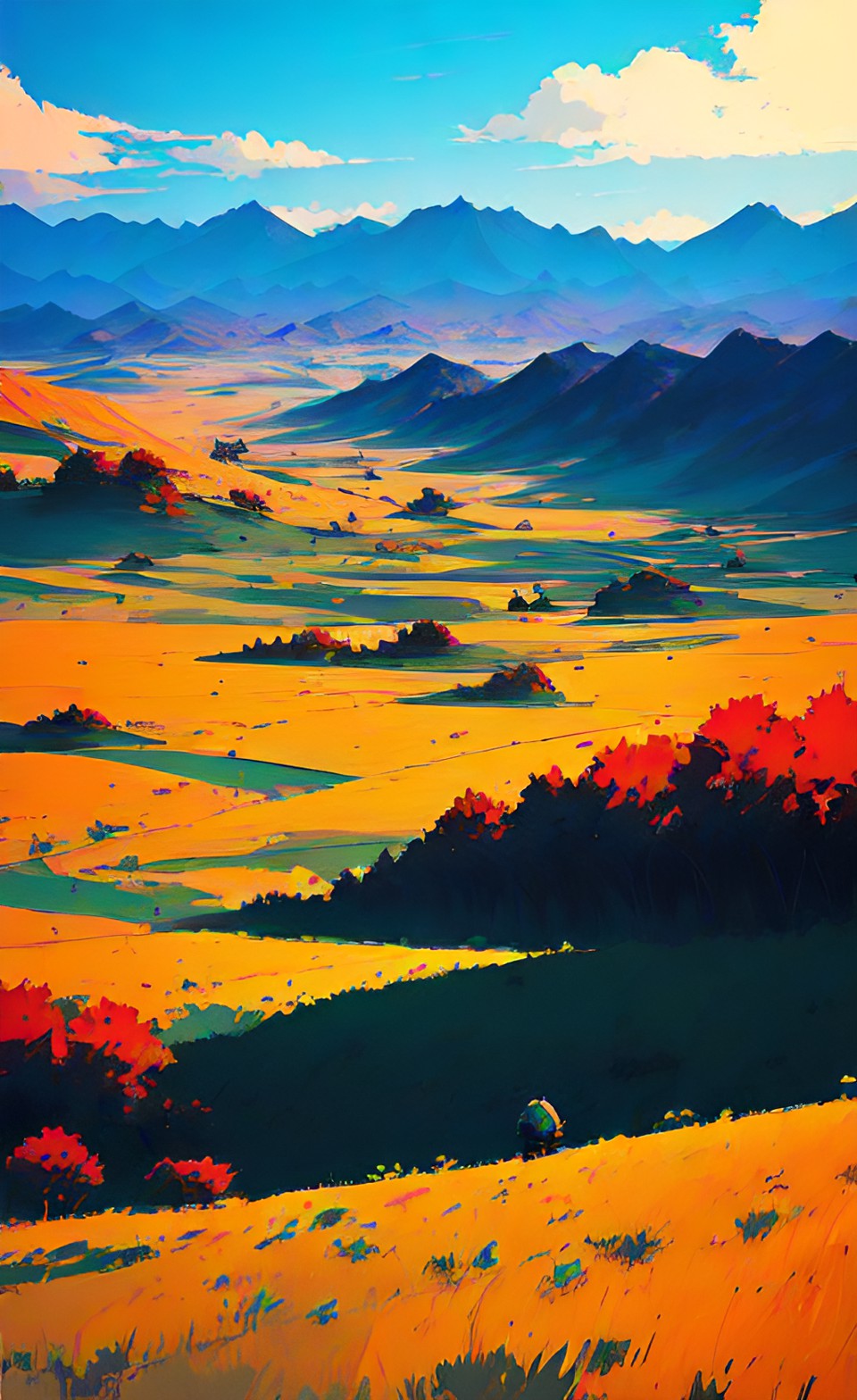
grasslands, steppe
uncommon
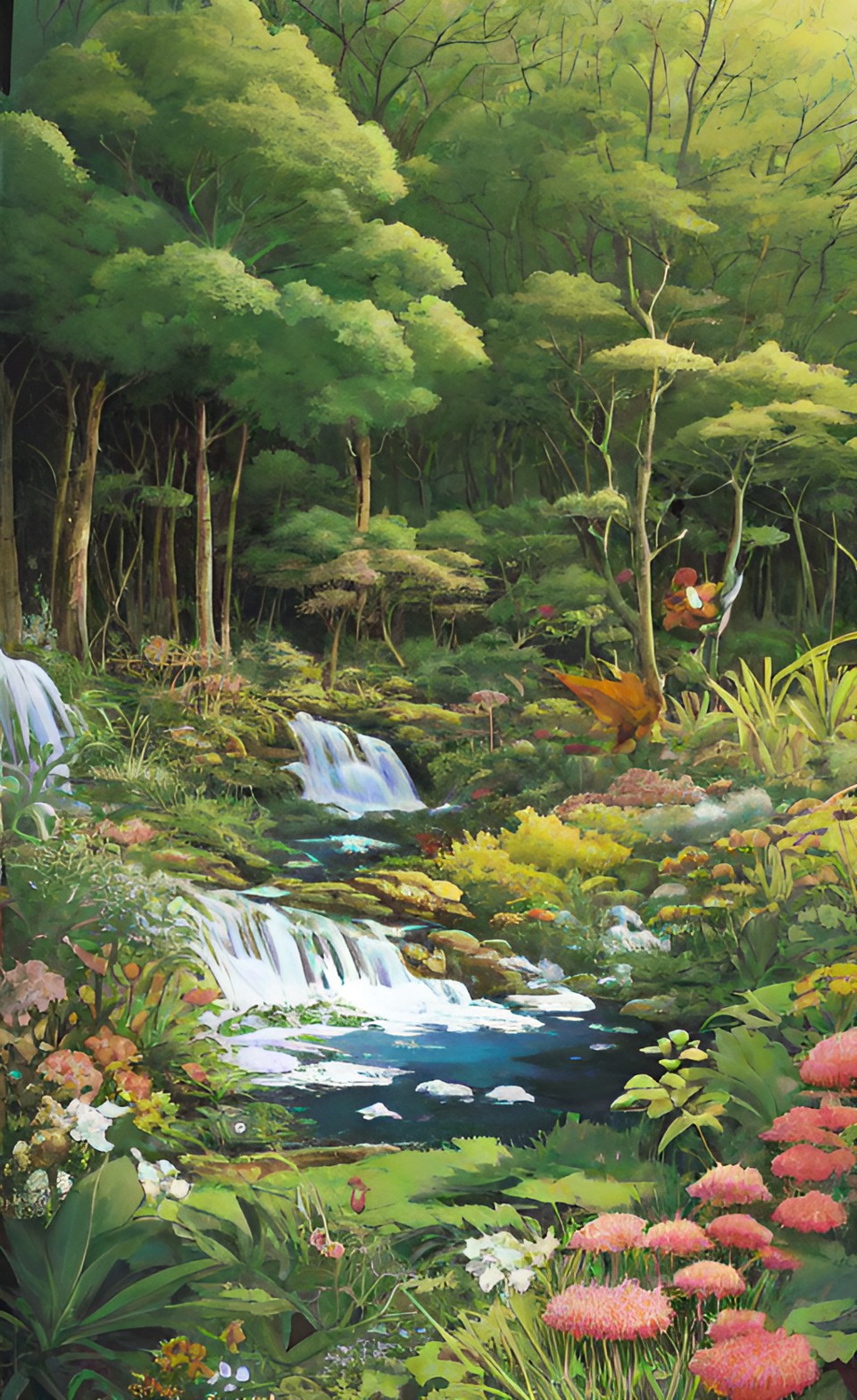
forest
uncommon
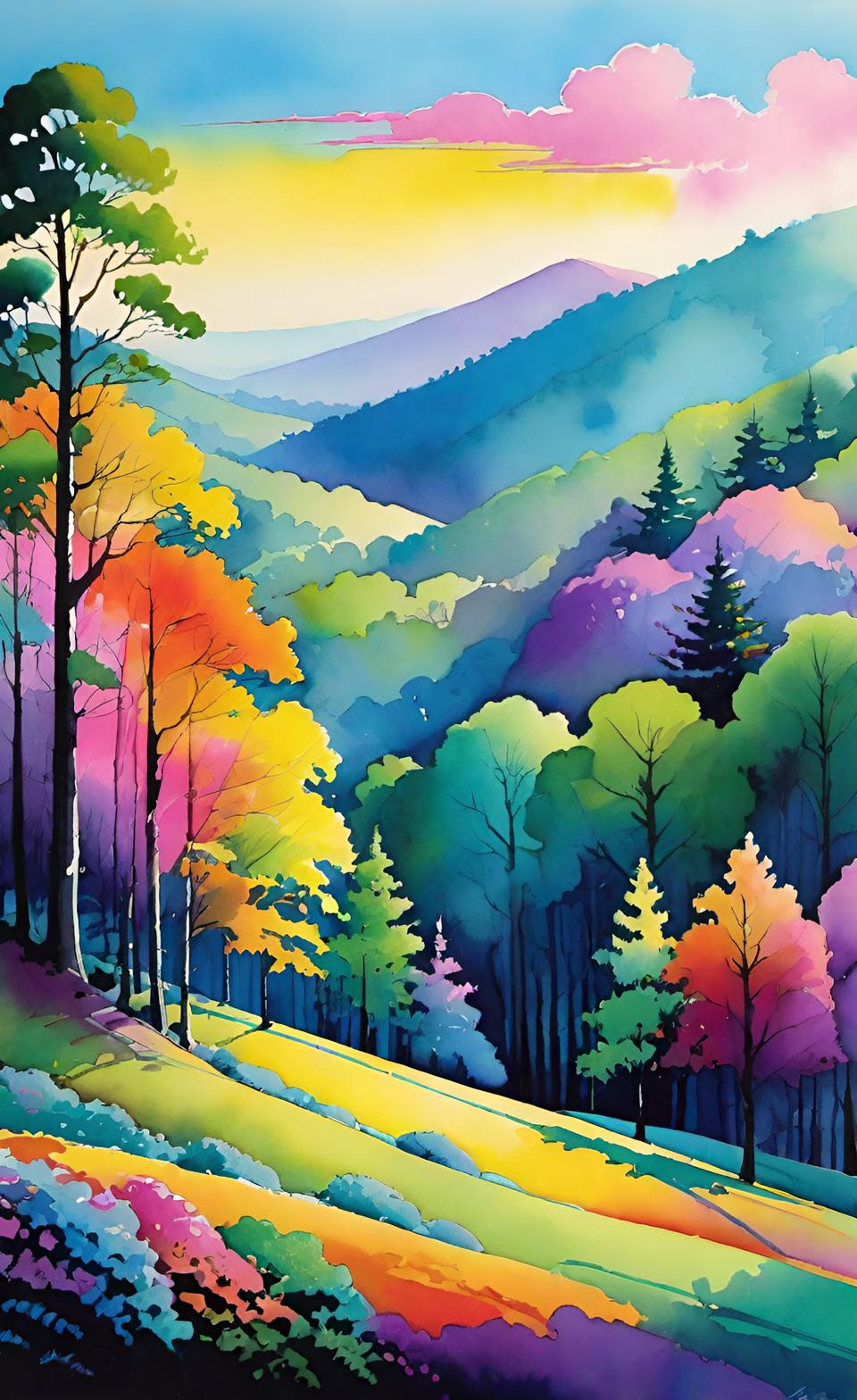
hills, forest
uncommon
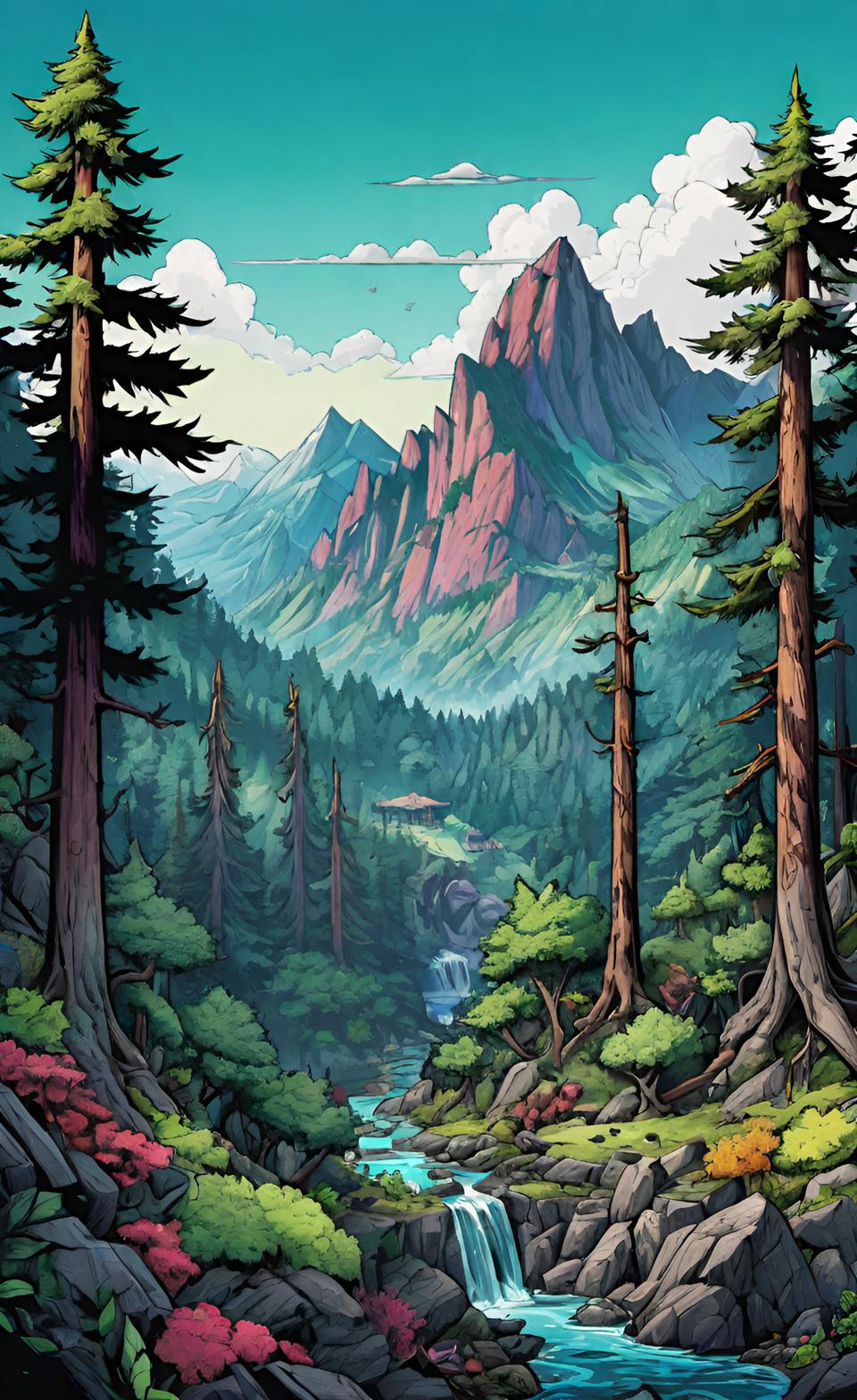
mountain, montane forest
rare
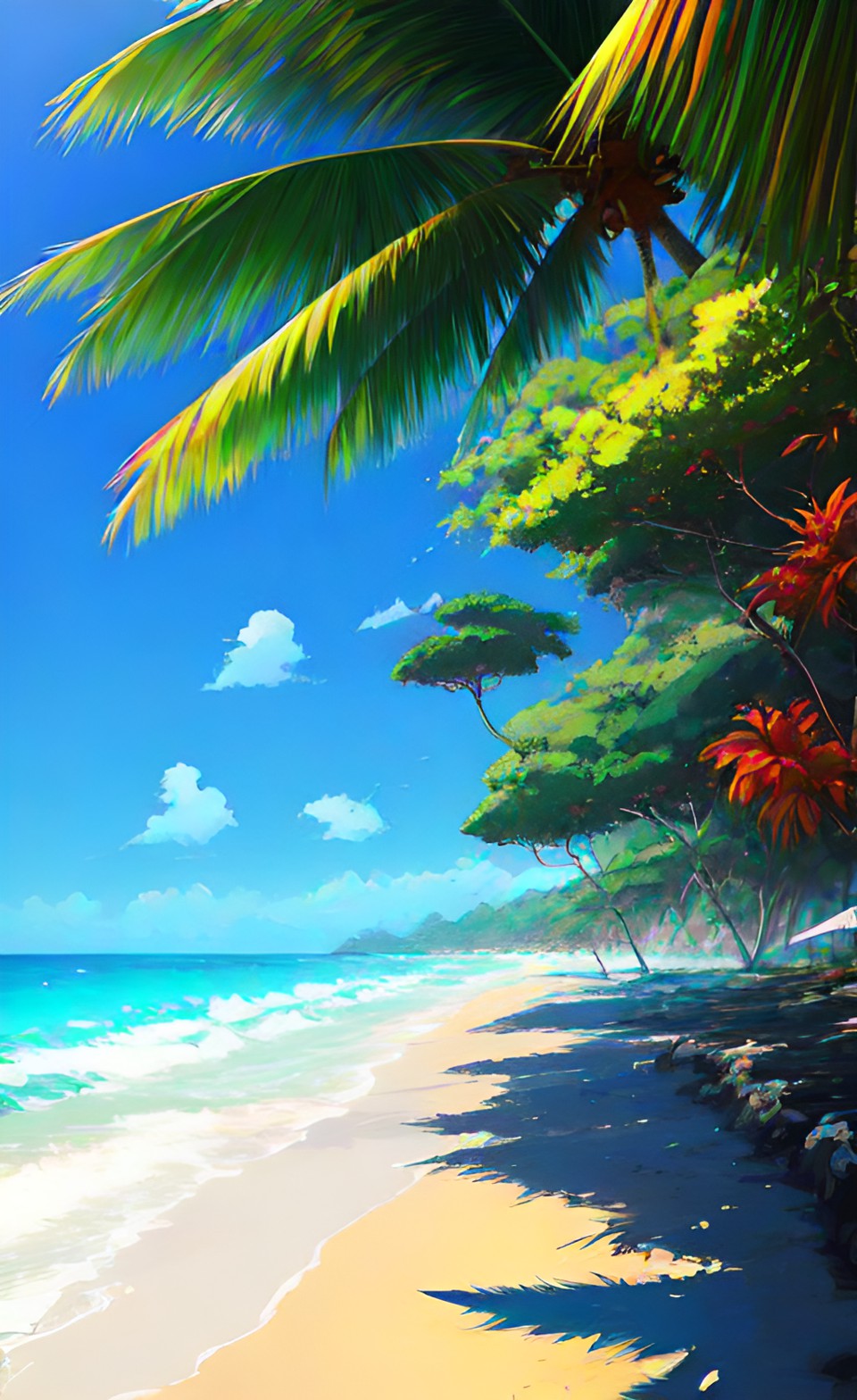
coast, tropical
rare
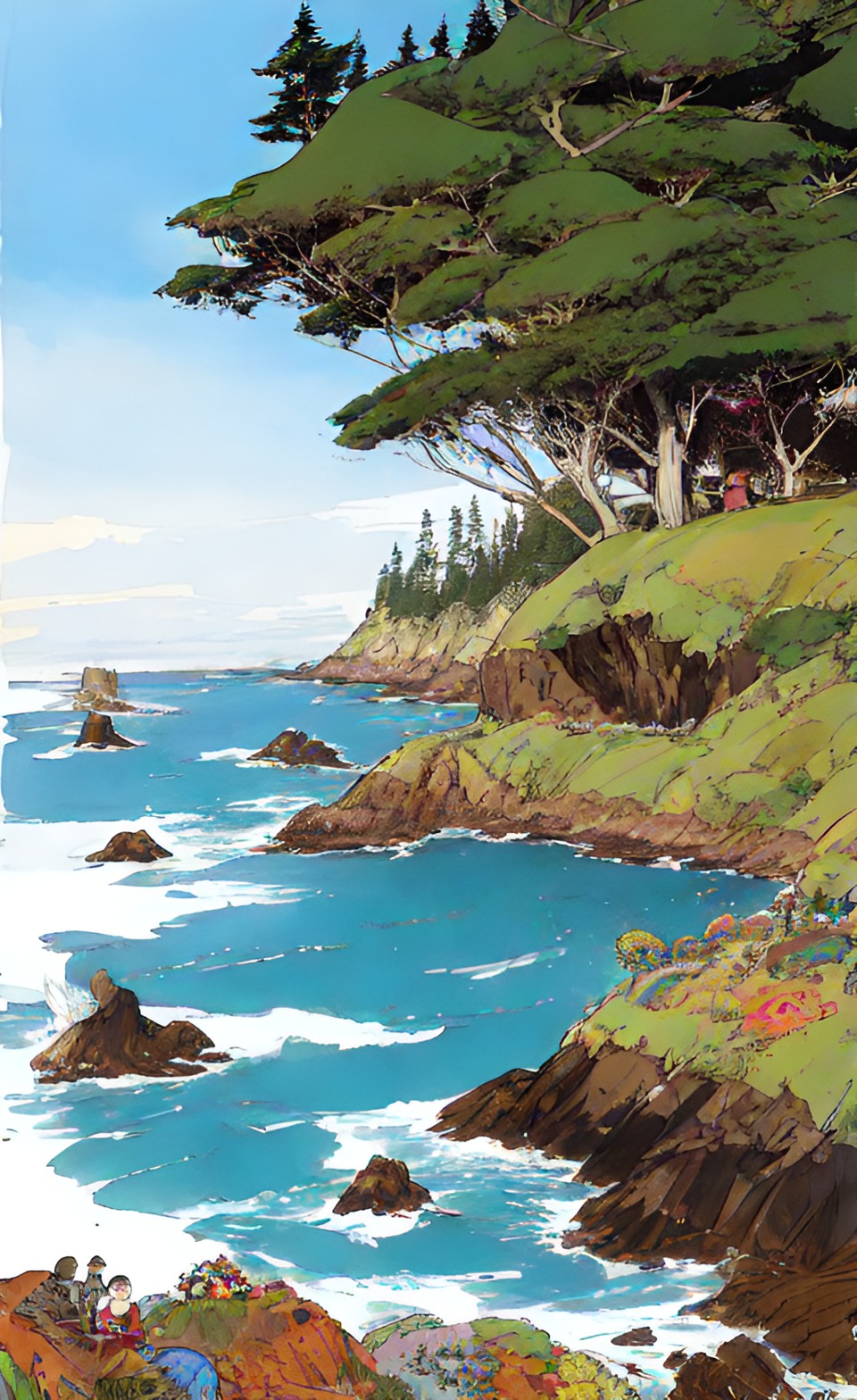
coast, temperate
rare





Flinds are a race closely related to gnolls. The two races share some strong similarities, and at first sight inexperienced adventurers could easily confuse the two. Flinds are much stockier than their lanky kin, much stronger and hardier, and are certainly more dangerous.
It is unknown if flinds are a subspecies of the gnoll or a genetic anomaly produced among large gnoll packs. Flinds are often found among gnoll bands acting as leaders, as their strength and relatively superior intelligence puts them above their lesser brethren.
Flind combat tactics are similar to those of gnolls. They prefer to strike from ambush, using terrain and concealment to their best advantage. They are most often seen acting in the role of leaders to gnoll bands, keeping discipline with a ruthless hand and little mercy.
When the demon lord Yeenoghu wants to create a particularly fearsome war band leader, he transforms an exceptionally strong and vicious gnoll into a demonic warrior known as a flind.
A war band of demon-worshiping gnolls typically contains only one flind, and that creature sets the war band's path. Because of its special connection to Yeenoghu, a flind uses demonic insight to guide the gnolls toward weak prey ripe for slaughter.
Unlike other leaders who might skulk behind their minions, a flind leads the charge in battle. Its flail causes wracking pain, paralysis, and disorientation in those it strikes.
When gnolls are weakened, they seek out isolated settlements, maim and disable its inhabitants, and feed upon them as they rest and regain strength.
A flind is an exceptionally strong and vicious gnoll that commands and directs the war band it is a part of. It wields a flail imbued with powerful magic by Yeenoghu himself.
A war band can have only one flind, and that creature sets a war band's path. Because of its special connection to Yeenoghu, a flind uses god-given omens and demonic insight to guide the gnolls toward weak prey ripe for slaughter.
Unlike other humanoid leaders that might skulk behind their minions, a flind leads the charge in battle. Its flail causes wracking pain, paralysis, and disorientation in those struck by it.
Close relatives of gnolls standing 6½-ft tall with powerful limbs and leonine heads
Flinds are close relatives of, and to a degree resemble, gnolls. Flinds stand 6½-ft tall, with powerful limbs and a leonine head. Both flinds and gnolls regard flinds as more highly evolved beings and any gnoll will regard a flind as having 16 charisma. Groups of gnolls are often led by one or more flinds and the gnolls will obey any order given by a flind without question. A gnoll defending its flind leader will not check for morale unless the flind is killed or hors de combat. Flinds share a common language with gnolls and can also speak bugbear, hobgoblin, ogrish, and orcish. Flinds are generally on friendly terms with these humanoid races and will work with them as need arises. For unknown reasons, flinds do not like and will not cooperate with trolls. In combat flinds swing crude clubs, using their great strength to gain +1 to hit. There is a 25% chance that each flind will wield a disarming weapon called a flindbar; a pair of iron bars linked by a short piece of chain. A flind wielding a flindbar gains two attacks per round for 1d4 hp damage. For every hit with a flindbar the victim must save vs aimed magic items or be disarmed. Regarding PC use of the flindbar: The wielder
Pack warriors make up the bulk of a gnoll tribe's fighting force, and while individually they are vicious and lethal, when attacking en masse they are a relentless horde.
In combat they are fearless, favoring numbers and ferocity as their primary (if somewhat rudimentary) tactic. A good war chieftain can go a long way in organizing this pack mob mentality into victory on the battlefield.
Gnolls are feral humanoids that attack settlements along the frontiers and borderlands of civilization without warning, slaughtering their victims and devouring their flesh.
Demonic Origin
The origin of the gnolls traces back to a time when the demon lord Yeenoghu found his way to the Material Plane and ran amok. Packs of ordinary hyenas followed in his wake, scavenging the demon lord's kills. Those hyenas were transformed into the first gnolls, parading after Yeenoghu until he was banished back to the Abyss. The gnolls then scattered across the face of the world, a dire reminder of demonic power.
Nomadic Destroyers
Gnolls are dangerous because they strike at random. They emerge from the wilderness, plunder and slaughter, then move elsewhere. They attack like a plague of locusts, pillaging settlements and leaving little behind but razed buildings, gnawed corpses, and befouled land. Gnolls choose easy targets for their raids. Armored warriors holed up in a fortified castle will survive a rampaging gnoll horde unscathed, even as the towns, villages, and farms that surround the castle are ablaze, their people slaughtered and devoured.
Gnolls rarely build permanent structures or craft anything of lasting value. They don't make weapons or armor, but scavenge such items from the corpses of their fallen victims, stringing ears, teeth, scalps, and other trophies from their foes onto their patchwork armor.
Thirst for Blood
No goodness or compassion resides in the heart of a gnoll. Like a demon, it lacks anything resembling a conscience, and can't be taught or coerced to put aside its destructive tendencies. The gnolls' frenzied bloodlust makes them an enemy to all, and when they lack a common foe, they fight among themselves. Even the most savage orcs avoid allying with gnolls.
Hyena-headed, evil humanoids that wander in loose tribes
Gnolls are hyena-headed, evil humanoids that wander in loose tribes. Most gnolls have dirty yellow or reddish-brown fur. An adult male gnoll is about 7½ feet tall and weighs 300 pounds. Gnolls are nocturnal, and have Darkvision with a 30' range. They are cruel carnivores, preferring intelligent creatures for food because they scream more. They show little discipline when fighting unless they have a strong leader.
Lazy, humanoid hyenas of low intelligence that live by intimidation and theft. Legends say that gnolls were magically created by a wizard who crossbred gnomes and trolls.
Hyena-headed, evil humanoids that wander in loose tribes
Gnolls live and travel in small bands. They sometimes form loose alliances with other gnolls. They are very adaptive and can be found in most climes. There are rumours of a gnoll overlord, though if he exists his power and reach are limited. Gnolls have been known to ally with orcs, hobgoblins, bugbears, and even trolls. Gnolls have infravision (60-ft). They speak troll, their own barked tongue, chaotic evil, and occasionally orcish and hobgoblin. Gnolls are large hyena-faced creatures. They are covered in a grey fur with a dark muzzle and yellow mane. They have dark eyes, and long nails. Their armour is usually a mismatch of types taken from their victims. They have a rough life, and their average lifespan is only 35 years.

Illustrated Bestiary
Miko Arc
Mariana Ruiz Villarreal
 (21)
(21)



 (26)
(26)
The Monsters Know What They're Doing Dungeons And Dragons
The Monsters Know What They're Doing 2 (moar) Dungeons And Dragons
OSE Encounter Activity Tables Any
Pathfinder 1e Bestiary 1 Pathfinder
Pathfinder 2e Bestiary 1 Pathfinder
Monster Codex Pathfinder
The Daily Bestiary Pathfinder
Classic Monsters Revisited Pathfinder
Flee, Mortals D&D 5e
Ultimate Bestiary: Revenge Of The Horde D&D 5e
Volo's Guide To Monsters D&D 5e
Monster Monday D&D 5e
Monster Ecology Anthology D&D 5e
Dungeons And Dragons Essentials: Monster Vault D&D 4e
Scruffy Grognard's Monstrous Manual D&D 2e
AD&D Monster Manual AD&D 1e
Dragonlance Bestiary SAGA
Hacklopedia Of Beasts Hackmaster v5
Monster Guide World Of Warcraft RPG
Manual Of Monsters World Of Warcraft RPG
Mystara Adversary Compendium I Dragon Age
Low Fantasy Gaming Companion Low Fantasy Gaming
OSE: Bestiary Of Cryptofauna OSR
Iron Falcon Handbook Of Monsters OSR
Baby Bestiary 1 Any