













To Draw Creatures From:



Your magic is strange and new
| Bearfolk | Beebear | Black Bear | Brown Bear | Cave Bear |
| Chaaor | Gici Awas | Grizzly Bear | Kalidah | Nanoqaluk |
| Owlbear | Piranha Bear | Poison Bear | Polar Bear | Skunkbear |
| Ursa Polaris | Urskan | Ursoi | Werebear |
 Actions/Abilities/Traits: D&D 5e
Actions/Abilities/Traits: D&D 5e
Actions/Abilities/Traits: D&D 5e
The dwarves selectively bred owlbears for toughness, ferocity, and slightly more discipline and intelligence. They also managed to introduce a bulette trait they considered desirable into the creatures: specifically, the ability to burrow rapidly. The dwarves termed the result "dire owlbears," although that label isn't really correct. Most "dire" creatures are primitive branches of a family tree that managed to survive for eons unchanged from more savage versions, usually in isolated regions far from civilization.
Because of the armor plating they wear, dire owlbears are sometimes misidentified as mutated or freakish bulettes by frightened travelers and farmers whose horses and other livestock these monstrosities prey on.
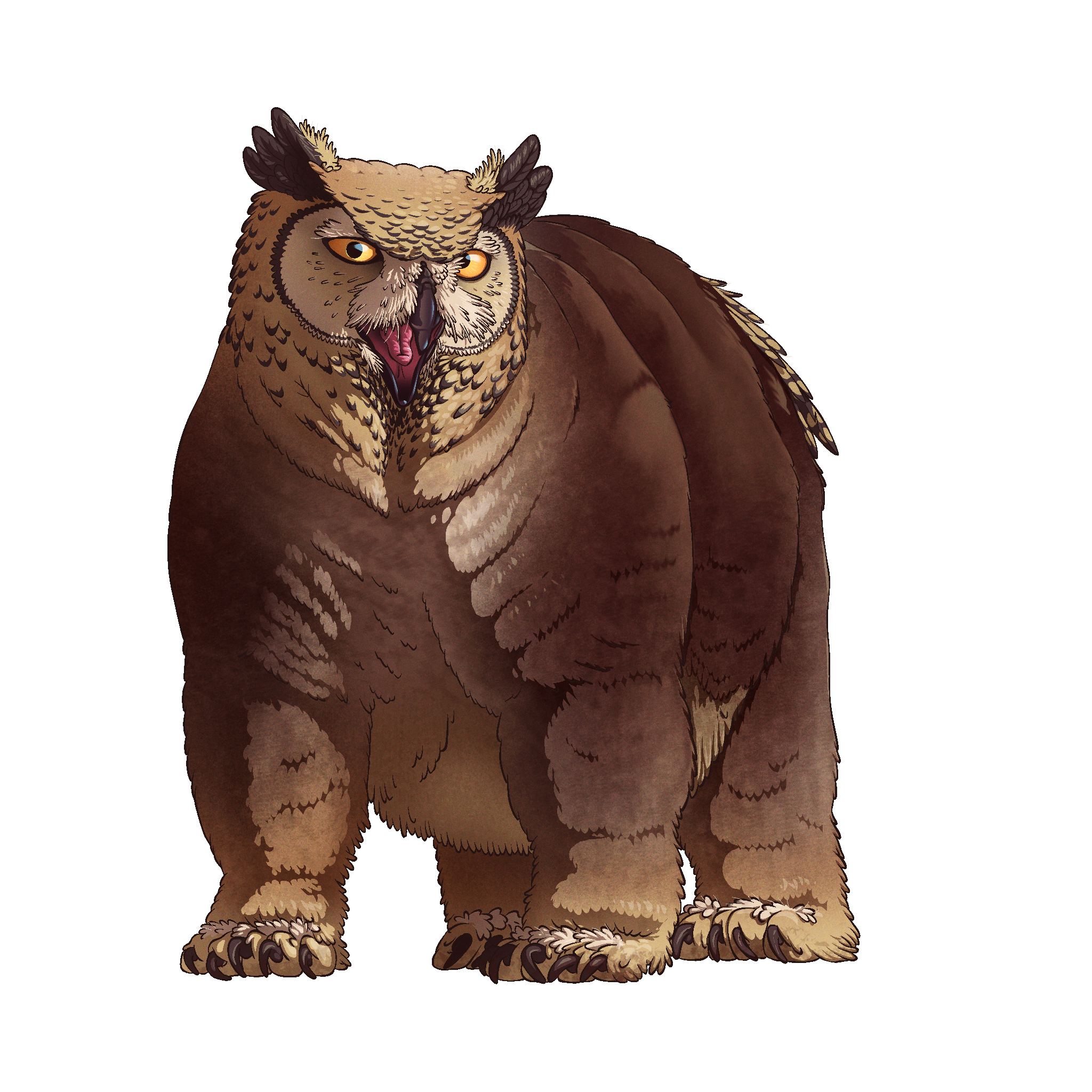
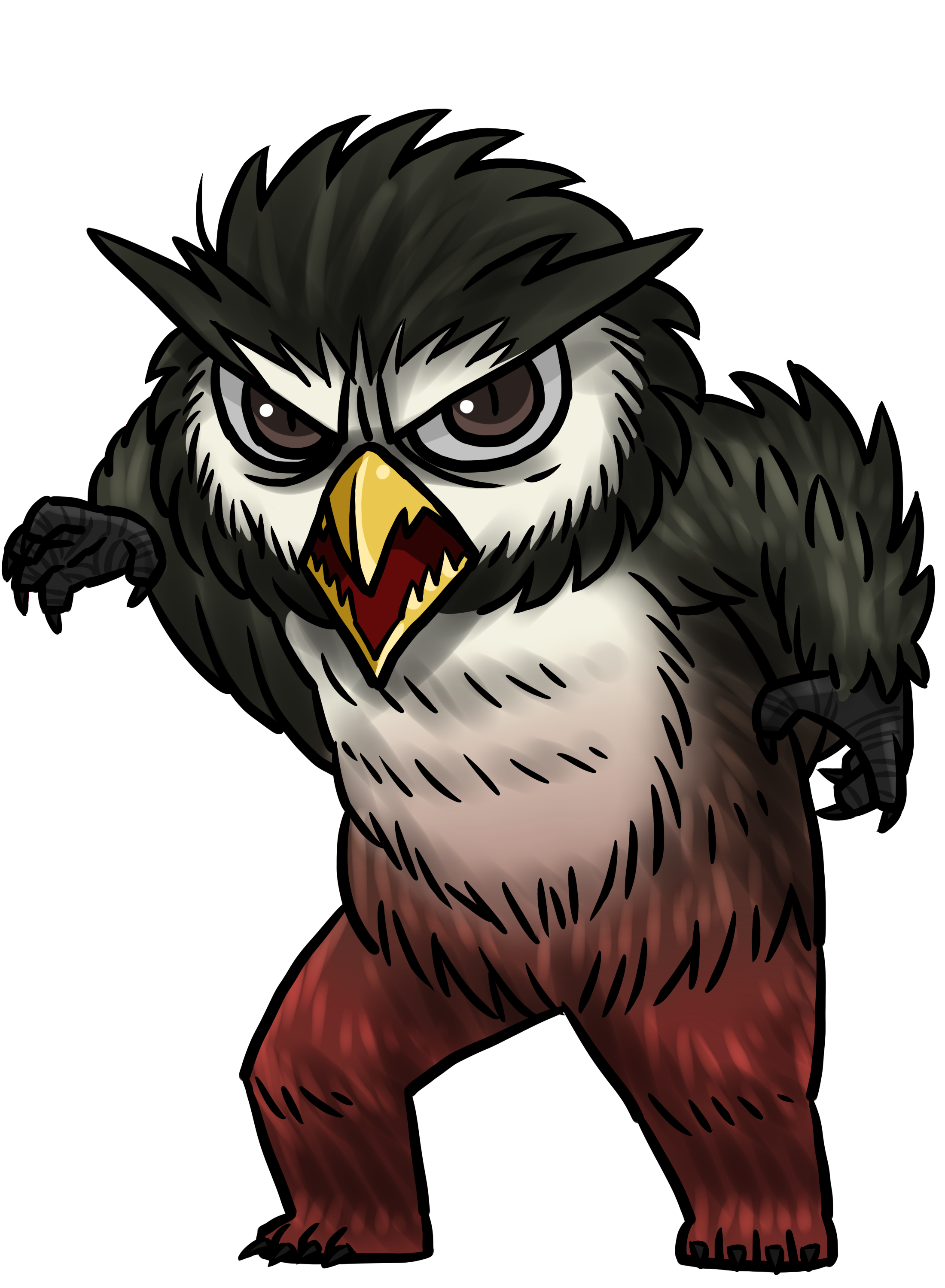
An owlbear's screech echoes through dark valleys and benighted forests, piercing the quiet night to announce the death of its prey. Feathers cover the thick, shaggy coat of its bearlike body, and the limpid pupils of its great round eyes stare furiously from its owlish head.
Deadly Ferocity
The owlbear's reputation for ferocity, aggression, stubbornness, and sheer ill temper makes it one of the most feared predators of the wild. There is little, if anything, that a hungry owlbear fears. Even monsters that outmatch an owlbear in size and strength avoid tangling with it, for this creature cares nothing about a foe's superior strength as it attacks without provocation.
Consummate Predators
An owlbear emerges from its den around sunset and hunts into the darkest hours of the night, hooting or screeching to declare its territory, to search for a mate, or to flush prey into its hunting grounds. These are typically forests familiar to the owlbear, and dense enough to limit its quarry's escape routes.
An owlbear makes its den in a cave or ruin littered with the bones of its prey. It drags partially devoured kills back to its den, storing portions of the carcass among the surrounding rocks, bushes, and trees. The scent of blood and rotting flesh hangs heavy near an owlbear's lair, attracting scavengers and thus luring more prey.
Owlbears hunt alone or in mated pairs. If quarry is plentiful, a family of owlbears might remain together for longer than is required to rear offspring. Otherwise, they part ways as soon as the young are ready to hunt.
Savage Companions
Although they are more intelligent than most animals, owlbears are difficult to tame. However, with enough time, food, and luck, an intelligent creature can train an owlbear to recognize it as a master, making it an unflinching guard or a fast and hardy mount. People of remote frontier settlements have even succeeded at racing owlbears, but spectators bet as often on which owlbear will attack its handler as they do on which will reach the finish line first.
Elven communities encourage owlbears to den beneath their treetop villages, using the beasts as a natural defense during the night. Hobgoblins favor owlbears as war beasts, and hill giants and frost giants sometimes keep owlbears as pets. A starved owlbear might show up in a gladiatorial arena, ruthlessly eviscerating and devouring its foes before a bloodthirsty audience.
Owlbear Origins
Scholars have long debated the origins of the owlbear. The most common theory is that a demented wizard created the first specimen by crossing a giant owl with a bear. However, venerable elves claim to have known these creatures for thousands of years, and some fey insist that owlbears have always existed in the Feywild.
The only good thing about owlbears is that the wizard who created them is probably dead.
Owlbears are tenacious hunters that might track prey over miles and rarely give up their hunts.
Actions/Abilities/Traits: D&D 5e
Actions/Abilities/Traits: OSRIC
Actions/Abilities/Traits: OSRIC
Nightmarish creatures with the body of a large bear and the head of an owl
These nightmarish creatures have the body of a large bear with the head of an owl. They are voracious eaters and possessed of a foul temper. They will attack anything that moves on sight and will fight to the death. They are typically found in temperate forests. The pelt of an owlbear ranges in colour from brownish-black to a golden-brown with feathers interspersed with the fur. Males weigh from 1,300 to 1,500 lbs and tend to have the darker colouration. The terrible beaks of these beasts vary from ivory to yellow in colour.
Actions/Abilities/Traits: OSRIC
Actions/Abilities/Traits: Pathfinder 1e
Actions/Abilities/Traits: Pathfinder 1e
Actions/Abilities/Traits: Pathfinder 1e

forest
rare

hills, forest
rare

The dwarves selectively bred owlbears for toughness, ferocity, and slightly more discipline and intelligence. They also managed to introduce a bulette trait they considered desirable into the creatures: specifically, the ability to burrow rapidly. The dwarves termed the result "dire owlbears," although that label isn't really correct. Most "dire" creatures are primitive branches of a family tree that managed to survive for eons unchanged from more savage versions, usually in isolated regions far from civilization.
Because of the armor plating they wear, dire owlbears are sometimes misidentified as mutated or freakish bulettes by frightened travelers and farmers whose horses and other livestock these monstrosities prey on.
An owlbear's screech echoes through dark valleys and benighted forests, piercing the quiet night to announce the death of its prey. Feathers cover the thick, shaggy coat of its bearlike body, and the limpid pupils of its great round eyes stare furiously from its owlish head.
Deadly Ferocity
The owlbear's reputation for ferocity, aggression, stubbornness, and sheer ill temper makes it one of the most feared predators of the wild. There is little, if anything, that a hungry owlbear fears. Even monsters that outmatch an owlbear in size and strength avoid tangling with it, for this creature cares nothing about a foe's superior strength as it attacks without provocation.
Consummate Predators
An owlbear emerges from its den around sunset and hunts into the darkest hours of the night, hooting or screeching to declare its territory, to search for a mate, or to flush prey into its hunting grounds. These are typically forests familiar to the owlbear, and dense enough to limit its quarry's escape routes.
An owlbear makes its den in a cave or ruin littered with the bones of its prey. It drags partially devoured kills back to its den, storing portions of the carcass among the surrounding rocks, bushes, and trees. The scent of blood and rotting flesh hangs heavy near an owlbear's lair, attracting scavengers and thus luring more prey.
Owlbears hunt alone or in mated pairs. If quarry is plentiful, a family of owlbears might remain together for longer than is required to rear offspring. Otherwise, they part ways as soon as the young are ready to hunt.
Savage Companions
Although they are more intelligent than most animals, owlbears are difficult to tame. However, with enough time, food, and luck, an intelligent creature can train an owlbear to recognize it as a master, making it an unflinching guard or a fast and hardy mount. People of remote frontier settlements have even succeeded at racing owlbears, but spectators bet as often on which owlbear will attack its handler as they do on which will reach the finish line first.
Elven communities encourage owlbears to den beneath their treetop villages, using the beasts as a natural defense during the night. Hobgoblins favor owlbears as war beasts, and hill giants and frost giants sometimes keep owlbears as pets. A starved owlbear might show up in a gladiatorial arena, ruthlessly eviscerating and devouring its foes before a bloodthirsty audience.
Owlbear Origins
Scholars have long debated the origins of the owlbear. The most common theory is that a demented wizard created the first specimen by crossing a giant owl with a bear. However, venerable elves claim to have known these creatures for thousands of years, and some fey insist that owlbears have always existed in the Feywild.
The only good thing about owlbears is that the wizard who created them is probably dead.
Owlbears are tenacious hunters that might track prey over miles and rarely give up their hunts.
Huge (8' tall, 1,500 pounds), ill-tempered, carnivorous bear-like creature with the face of an owl. Owl bears are found in dense forests and underground.
Nightmarish creatures with the body of a large bear and the head of an owl
These nightmarish creatures have the body of a large bear with the head of an owl. They are voracious eaters and possessed of a foul temper. They will attack anything that moves on sight and will fight to the death. They are typically found in temperate forests. The pelt of an owlbear ranges in colour from brownish-black to a golden-brown with feathers interspersed with the fur. Males weigh from 1,300 to 1,500 lbs and tend to have the darker colouration. The terrible beaks of these beasts vary from ivory to yellow in colour.

Illustrated Bestiary
Miko Arc
 (23)
(23)



 (26)
(26)
The Monsters & Creatures Compendium Any
Dracopedia Bestiary: An Artist's Guide Any
The Monsters Know What They're Doing Dungeons And Dragons
Angry Golem D&D 5e
Atlas Animalia Any
OSE Encounter Activity Tables Any
Pathfinder 1e Bestiary 1 Pathfinder
Pathfinder 2e Bestiary 1 Pathfinder
The Daily Bestiary Pathfinder
Dungeon Denizens Revisited Pathfinder
All Sorts Of Critters Pathfinder
Mythic Adventures Pathfinder
Talented Bestiary Pathfinder
Flee, Mortals D&D 5e
Fortuan's Ecologies D&D 5e
Monster Ecology Anthology D&D 5e
Dungeons And Dragons Essentials: Monster Vault D&D 4e
Scruffy Grognard's Monstrous Manual D&D 2e
AD&D Monster Manual AD&D 1e
The Petersen Bestiary Torchbearer
Mystara Adversary Compendium I Dragon Age
Monsters Of Luclin Everquest
Lairs And Encounters Adventurer, Conqueror, King
Baby Bestiary 1 Any