











To Draw Creatures From:



Your magic is strange and new
 Actions/Abilities/Traits: Basic Fantasy
Actions/Abilities/Traits: Basic Fantasy
Actions/Abilities/Traits: Basic Fantasy
Reptile-like monsters with multiple heads, gray-brown to dark brown with light yellow or tan underbelly
Hydras are reptile-like monsters with multiple heads. They are gray-brown to dark brown, with a light yellow or tan underbelly. The eyes are amber and the teeth are yellow-white. Hydras are about 20 feet long and weigh about 4,000 pounds. They are bad-tempered and territorial, but not particularly cunning. A hydra may be slain by damage in the normal fashion; however, most who fight them choose to strike at their heads. If a character using a melee weapon chooses to strike at a particular head, and succeeds in doing 8 points of damage, that head is disabled (severed or severely damaged) and will not be able to attack anymore. Such damage also applies to the monster's total hit points, of course. Some hydras live in the ocean; use the given movement as a swimming rate rather than walking in this case. A very few hydras can breathe fire; those that have this ability can emit a flame 10' wide and 20' long one time per head per day. This attack will be used about one time in three (1-2 on 1d6) if it is available; roll for each head which is attacking. Each such attack does 3d6 damage, with a save vs. Dragon Breath reducing the amount by half.
Actions/Abilities/Traits: Basic Fantasy
Actions/Abilities/Traits: D&D 5e
Actions/Abilities/Traits: D&D 5e
What at first appeared to be multiple snakes tangled up with each other is in fact a multi-headed best, all of them connected to one large serpent body.
Hydras are reptile-like monsters with nine heads. A hydra is gray brown to dark brown, with a light yellow or tan underbelly. The eyes are amber, and the teeth are yellow-white. It is about 20 feet long and weighs about 4,000 pounds.
Deadly by Nature. Hydras are extremely poisonous, such that their blood is used in arrows to slay even more fearsome opponents. Their breath is dire enough to kill a man where he stands, but even the miasma that surrounds them can poison attackers even while the hydra sleeps.
The hydra is a reptilian horror with a crocodilian body and multiple heads on long, serpentine necks. Although its heads can be severed, the hydra magically regrows them in short order. A typical specimen has five heads. At the dawn of time, Tiamat, the Queen of Evil Dragons, slew a rival dragon god named Lernaea and cast her blood across the multiverse. Each drop that fell upon a world spawned a multi-headed hydra consumed by a hunger as great as the fallen god's hatred. Great champions are known to test their mettle against these fearsome creatures.
Everlasting Hunger
A rapacious and gluttonous monster, a hydra snatches and tears apart its prey in a frenzy of feeding. When a hydra has cleared a territory of food and driven off any creatures smart enough to avoid it, it moves on to seek its meals elsewhere. A hydra's hunger is so great that if it can't feed, it might turn against itself, its heads attacking each other as the creature eats itself alive.
Hardy Water Dwellers
Hydras are natural swimmers, dwelling in rivers, along lakeshores, in ocean shallows, and in wetland bogs. A hydra rarely requires shelter from the elements, so it doesn't normally have a lair. Only in colder climes are hydras drawn to the protection of sheltered caverns and ruins. When a hydra sleeps, at least one of its heads remains awake and alert, making the creature difficult to catch by surprise.
Hydras are giant lizards resembling iguanas, with multiple heads set atop long, snakelike necks. Aether traces whorling patterns through their scales, shapes the crests running down their necks and tails, and glows blue within the skin under their chins. Most hydras have five or six heads, but small hydras with as few as three heads—as well as enormous specimens with eight or more—have been seen in the deep forests far from Ghirapur.
Hydras are fierce predators, favoring prey that has absorbed large quantities of aether from the environment. This taste for aether also leads them to devour aether-powered machines whenever they encounter such devices, from thopters to automatons. In the remote wilderness near Peema where hydras are plentiful, such altercations are rarely an issue. But in the rare event of a hydra coming too close to civilization—or even wandering into one of Ghirapur's greenbelts—they can cause widespread destruction in their hunt for aether.
Use the hydra statistics in the Monster Manual|MM.
Hydra
Multiheaded Serpent of Legend
Hydras are storied hero slayers with vicious, serpentine heads and infamous regenerative powers. Endlessly hungry, they devour any creatures they catch. Hydras that deplete an area of prey often go into a lengthy torpor until new prey arrives.
Most hydras have five heads, but some mature or battle-tested hydras have more. Such elder hydras might become local legends, known for their battles with heroes or for the riches lost in their domains.
While many hydras claim their own territories, wicked deities might use them to guard treasures or magical sites. Roll on or choose a result from the Hydra Lairs table to inspire why a hydra lurks where it does.
Actions/Abilities/Traits: D&D 5e
Actions/Abilities/Traits: D&D 5e (Ironscale Hydra)
Actions/Abilities/Traits: D&D 5e (Ironscale Hydra)
Five-headed ironscale hydras lurk in the wild places of the world, being common foes for heroes seeking to test their mettle against terrors worthy of the gods' notice. Most ironscale hydras inhabit lakes and boggy caverns, from which they hunt unwary creatures that come for a drink or swim.
What krakens are to the sea and dragons are to the sky, hydras are to the lands of Theros. Various hydras dwell at the fringes of civilization, from the bog-dwelling hydras known across the multiverse to massive ironscale hydras that lurk in deep wildernesses. Beyond even these exist serpentine horrors born of the whims of foul gods, like the legendary hydra Polukranos.
Actions/Abilities/Traits: D&D 5e (Ironscale Hydra)
Actions/Abilities/Traits: D&D 5e (Snapping Hydra)
Actions/Abilities/Traits: D&D 5e (Snapping Hydra)
A rare variety of hydra native to the wilds of Eldraine, snapping hydras resemble giant, many-headed turtles. Snapping hydras dwell at the bottom of the wild's largest lakes, or along shorelines where the wilds meet the ocean. These monstrous creatures are aptly named; their bites are known to snap giants' arms cleanly in half.
Snapping hydras have naturally long life spans and strong instincts of self-preservation. When a snapping hydra feels a battle's odds tipping out of its favor, the hydra lets out a raspy screech and retracts into its shell. In the wilds of Eldraine, it's never long before a hungry or curious creature arrives to investigate, leaping into battle with the hydra's foes while the hydra makes an opportune exit.
Actions/Abilities/Traits: D&D 5e (Snapping Hydra)
Actions/Abilities/Traits: OSRIC
Actions/Abilities/Traits: OSRIC
Reptile-like monsters with multiple heads, gray-brown to dark brown with light yellow or tan underbelly
A hydra is a multi-headed reptilian monster that lives in damp, dark places like swamps, bogs, or marshes. Sometimes they are found underground if the lair is sufficiently dank and wet. Hydras have reptilian bodies, four legs, a tail and 1d12+4 heads. Each head counts as 1 hit die and has 8 full hit points, so a 10 headed hydra will have 10 hit die and 80 hp. Each head can attack independently or up to four heads can attack a single target. The damage a hydra does is based on the number of heads. A hydra with 5 or 6 heads is considered small and does 1d6 points of damage. One with 7 to 10 heads is considered medium and does 1d8 points of damage. One with 11 or 12 heads is considered large and does 1d10 points of damage, and one with 13 to 16 heads is considered huge and does 1d12 damage. The colouration of a hydra ranges from light brown to an almost blackish brown with a yellow or tan underbelly. Their eyes range from yellow to orange.
Actions/Abilities/Traits: OSRIC
Actions/Abilities/Traits: Pathfinder 1e
Actions/Abilities/Traits: Pathfinder 1e
Actions/Abilities/Traits: Pathfinder 1e

wetlands, swamp
very rare

wetlands, marsh
very rare

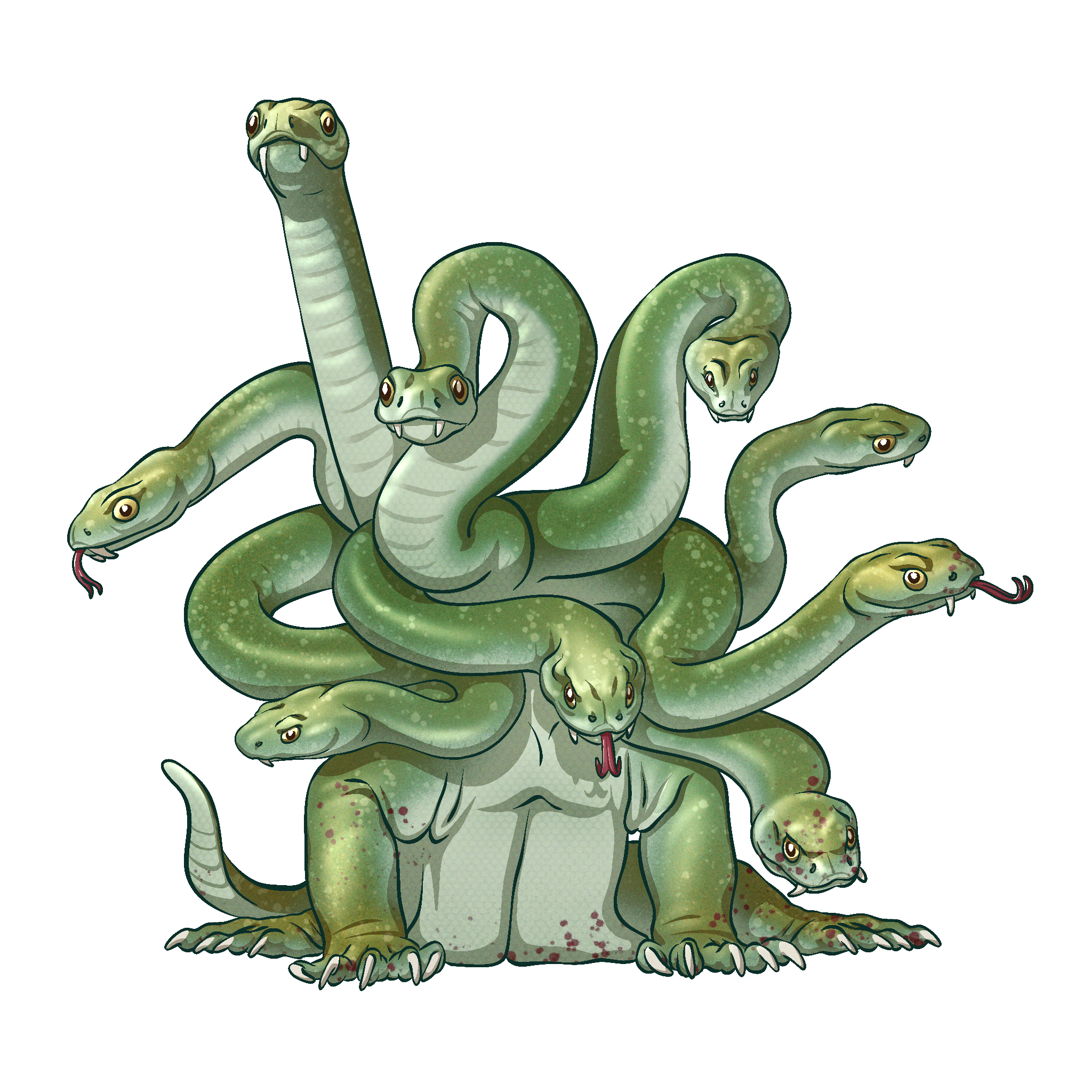
What at first appeared to be multiple snakes tangled up with each other is in fact a multi-headed best, all of them connected to one large serpent body.
Hydras are reptile-like monsters with nine heads. A hydra is gray brown to dark brown, with a light yellow or tan underbelly. The eyes are amber, and the teeth are yellow-white. It is about 20 feet long and weighs about 4,000 pounds.
Deadly by Nature. Hydras are extremely poisonous, such that their blood is used in arrows to slay even more fearsome opponents. Their breath is dire enough to kill a man where he stands, but even the miasma that surrounds them can poison attackers even while the hydra sleeps.
The hydra is a reptilian horror with a crocodilian body and multiple heads on long, serpentine necks. Although its heads can be severed, the hydra magically regrows them in short order. A typical specimen has five heads. At the dawn of time, Tiamat, the Queen of Evil Dragons, slew a rival dragon god named Lernaea and cast her blood across the multiverse. Each drop that fell upon a world spawned a multi-headed hydra consumed by a hunger as great as the fallen god's hatred. Great champions are known to test their mettle against these fearsome creatures.
Everlasting Hunger
A rapacious and gluttonous monster, a hydra snatches and tears apart its prey in a frenzy of feeding. When a hydra has cleared a territory of food and driven off any creatures smart enough to avoid it, it moves on to seek its meals elsewhere. A hydra's hunger is so great that if it can't feed, it might turn against itself, its heads attacking each other as the creature eats itself alive.
Hardy Water Dwellers
Hydras are natural swimmers, dwelling in rivers, along lakeshores, in ocean shallows, and in wetland bogs. A hydra rarely requires shelter from the elements, so it doesn't normally have a lair. Only in colder climes are hydras drawn to the protection of sheltered caverns and ruins. When a hydra sleeps, at least one of its heads remains awake and alert, making the creature difficult to catch by surprise.
Hydras are giant lizards resembling iguanas, with multiple heads set atop long, snakelike necks. Aether traces whorling patterns through their scales, shapes the crests running down their necks and tails, and glows blue within the skin under their chins. Most hydras have five or six heads, but small hydras with as few as three heads—as well as enormous specimens with eight or more—have been seen in the deep forests far from Ghirapur.
Hydras are fierce predators, favoring prey that has absorbed large quantities of aether from the environment. This taste for aether also leads them to devour aether-powered machines whenever they encounter such devices, from thopters to automatons. In the remote wilderness near Peema where hydras are plentiful, such altercations are rarely an issue. But in the rare event of a hydra coming too close to civilization—or even wandering into one of Ghirapur's greenbelts—they can cause widespread destruction in their hunt for aether.
Use the hydra statistics in the Monster Manual|MM.
Hydra
Multiheaded Serpent of Legend
Hydras are storied hero slayers with vicious, serpentine heads and infamous regenerative powers. Endlessly hungry, they devour any creatures they catch. Hydras that deplete an area of prey often go into a lengthy torpor until new prey arrives.
Most hydras have five heads, but some mature or battle-tested hydras have more. Such elder hydras might become local legends, known for their battles with heroes or for the riches lost in their domains.
While many hydras claim their own territories, wicked deities might use them to guard treasures or magical sites. Roll on or choose a result from the Hydra Lairs table to inspire why a hydra lurks where it does.
Reptile-like monsters with multiple heads, gray-brown to dark brown with light yellow or tan underbelly
Hydras are reptile-like monsters with multiple heads. They are gray-brown to dark brown, with a light yellow or tan underbelly. The eyes are amber and the teeth are yellow-white. Hydras are about 20 feet long and weigh about 4,000 pounds. They are bad-tempered and territorial, but not particularly cunning. A hydra may be slain by damage in the normal fashion; however, most who fight them choose to strike at their heads. If a character using a melee weapon chooses to strike at a particular head, and succeeds in doing 8 points of damage, that head is disabled (severed or severely damaged) and will not be able to attack anymore. Such damage also applies to the monster's total hit points, of course. Some hydras live in the ocean; use the given movement as a swimming rate rather than walking in this case. A very few hydras can breathe fire; those that have this ability can emit a flame 10' wide and 20' long one time per head per day. This attack will be used about one time in three (1-2 on 1d6) if it is available; roll for each head which is attacking. Each such attack does 3d6 damage, with a save vs. Dragon Breath reducing the amount by half.
Large, dragon-like creatures with multiple, serpentine heads. Sea hydras (adapted to water, with fins) also exist.
Reptile-like monsters with multiple heads, gray-brown to dark brown with light yellow or tan underbelly
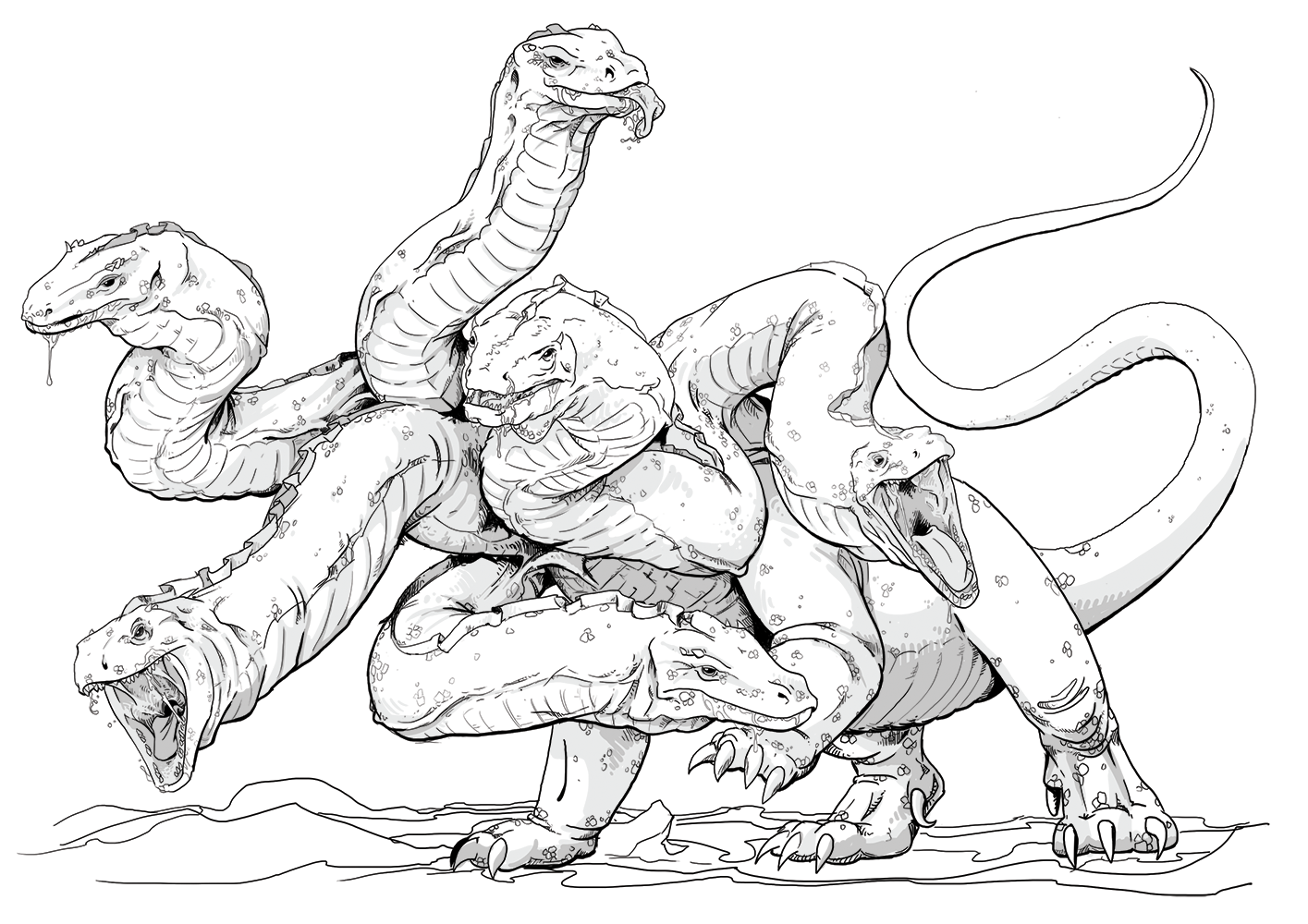
A hydra is a multi-headed reptilian monster that lives in damp, dark places like swamps, bogs, or marshes. Sometimes they are found underground if the lair is sufficiently dank and wet. Hydras have reptilian bodies, four legs, a tail and 1d12+4 heads. Each head counts as 1 hit die and has 8 full hit points, so a 10 headed hydra will have 10 hit die and 80 hp. Each head can attack independently or up to four heads can attack a single target. The damage a hydra does is based on the number of heads. A hydra with 5 or 6 heads is considered small and does 1d6 points of damage. One with 7 to 10 heads is considered medium and does 1d8 points of damage. One with 11 or 12 heads is considered large and does 1d10 points of damage, and one with 13 to 16 heads is considered huge and does 1d12 damage. The colouration of a hydra ranges from light brown to an almost blackish brown with a yellow or tan underbelly. Their eyes range from yellow to orange.

Illustrated Bestiary
Mariana Ruiz Villarreal
 (16)
(16)


 (24)
(24)
The Monsters Know What They're Doing Dungeons And Dragons
Atlas Animalia Any
OSE Encounter Activity Tables Any
Pathfinder 1e Bestiary 1 Pathfinder
Pathfinder 2e Bestiary 1 Pathfinder
The Daily Bestiary Pathfinder
Mythical Monsters Revisted Pathfinder
Mythic Adventures Pathfinder
Monster Monday D&D 5e
Monster Ecology Anthology D&D 5e
Dungeons And Dragons Essentials: Monster Vault D&D 4e
Dragon Magazine D&D 2e/3e
Scruffy Grognard's Monstrous Manual D&D 2e
Dragonlance Bestiary SAGA
Hacklopedia Of Beasts Hackmaster v5
Dragonbane Bestiary Dragonbane
Monsters Compendium Heroes Of Adventure
Godforsaken Cypher System
QUERP Bestiary QUERP
Beyond The Black Sea Bestiary Beyond The Black Sea (Dark Stars)
Lairs And Encounters Adventurer, Conqueror, King
Baby Bestiary 2 Any